
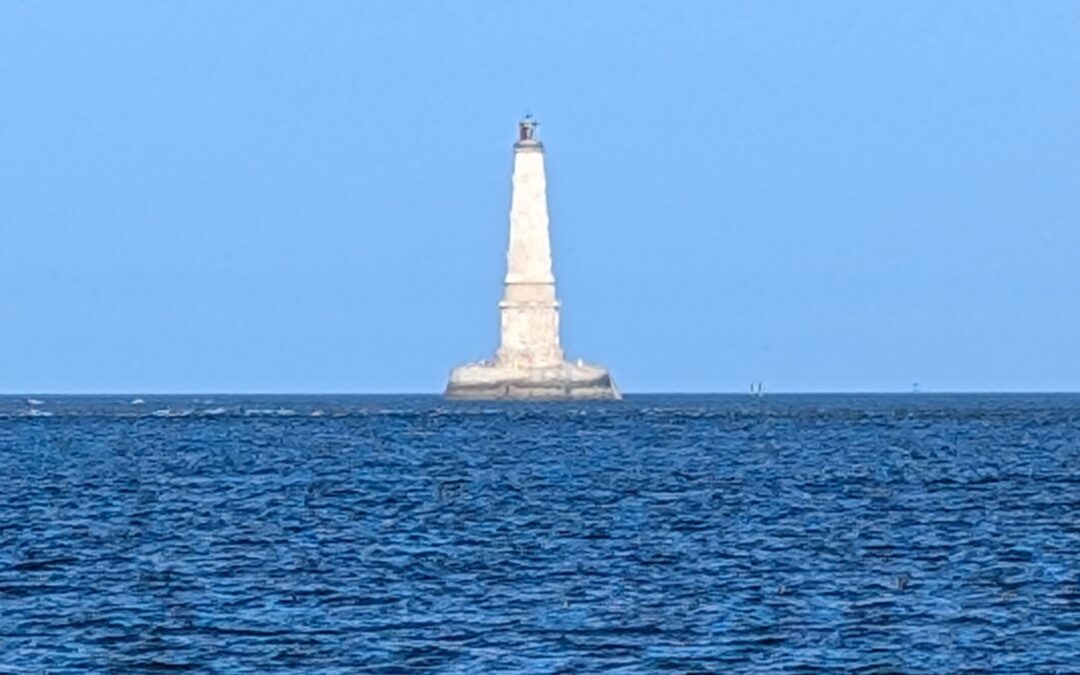
In these dark times, I decided to visit a lighthouse. Like most of us, I needed a beacon of hope.
And what a lighthouse it was.
I chose Cordouan mainly because it was easier to reach from Paris than the lighthouses around Brittany. I didn’t realize at first that it was also the oldest lighthouse in France, at more than 400 years, and that it stands in the middle of the ocean. And that it literally had been built for a king.
The web site recommended accessing Cordouan from Royan, a small beach town at the estuary of the Garonne and Dordogne Rivers—the largest estuary in Western Europe. (This trip produced a lot of superlatives.) Royan today is a slightly downmarket resort with popup amusement parks near the beach and a wide, curved sandy beach.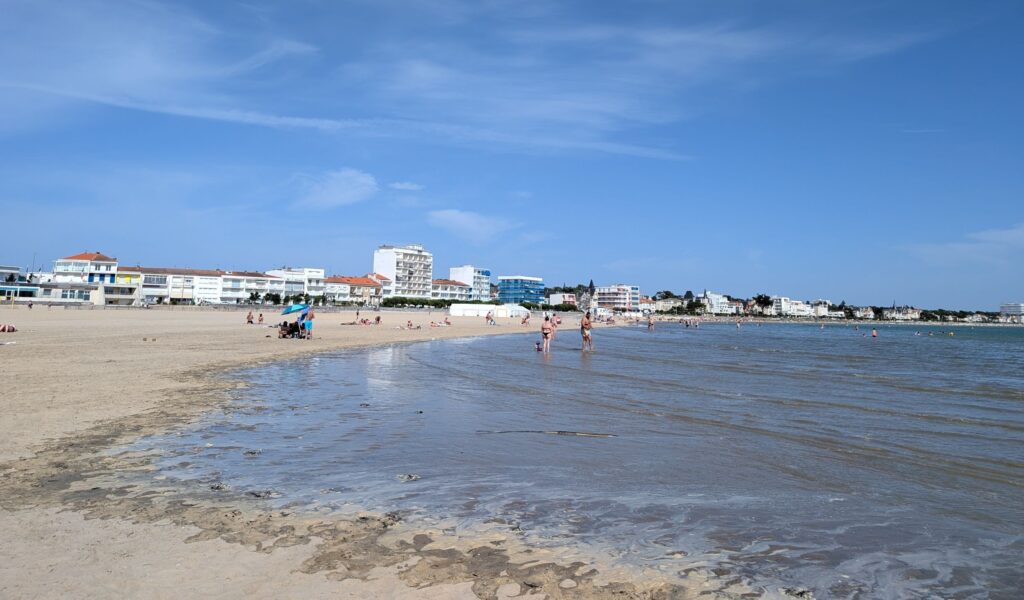
The town’s sad claim to fame is that most of it was destroyed during World War II—by the Allies! In 1945! The British and the Americans were determined to wipe out a pocket of Nazis in the town and in the process knocked down 5,000 buildings and killed at least 500 people. These photos show how extensive the damage was.
I told the lady who checked me in at the hotel that I was there to visit Cordouan the next day and she nodded. “Many people do, it’s the light of our tourism industry.” Yes, that pun works in French.
Our ship to the lighthouse was to leave from the Royan port at 8 a.m. Visits are complicated by the tide, which totally prevents access when it’s high. I was told to bring water shoes because walking through the ocean is the only way to reach the lighthouse at certain tides. Also, there would be no food or drink sold there, so I had to bring a little picnic and my own water. A lot of stuff management.
I knew that my fellow travelers were of the walking-stick-intrepid-outdoor-hiker variety when I arrived at the assigned hour of 7:30 a.m.: There was already a long line to get on the boat. The ride took about 45 minutes for the roughly 60 of us, on a beautiful day with perfect temperatures.
I hadn’t realized until we got closer that the lighthouse is just that. No island, no surrounding land. Apparently there was an actual island—the Ile de Cordouan—when the first version of a tower was built by England’s Edward, the Black Prince, in the 1330s. By the time the bottom stories of this one were constructed under Henri III in 1584, the land was starting to erode away. There was still enough rock, under Henri IV, for a stable with horses and buildings to house some 50 people.
By 1727 it was all gone (Check the video in this link.). The top, conical part of the lighthouse was added in 1790, bringing the full height to 67 meters (220 feet).
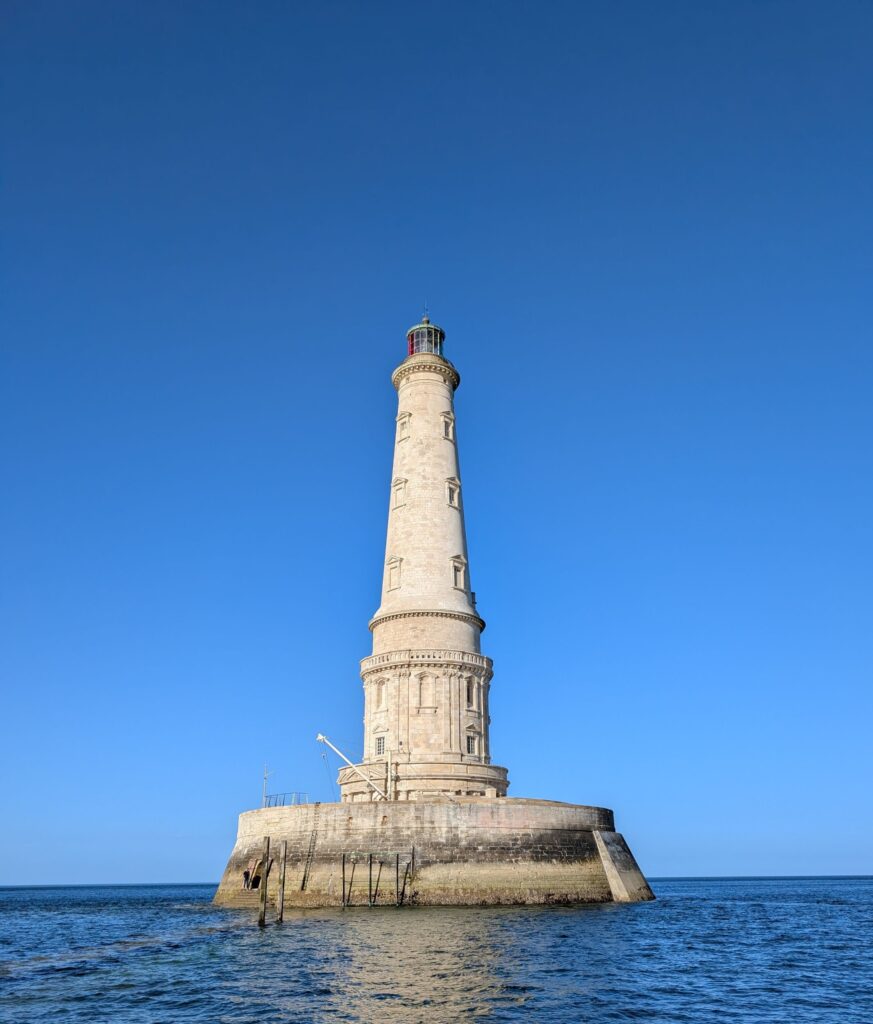
One result: High tide is above the entrance door, seen at the lower left in the above photo with the tiny figure standing there. The dark ring in the limestone wall around the perimeter shows the high-water mark. In other words, Cordouan is completely inaccessible except for a roughly 4-6 hour window each day, in good weather. I presume the nighttime window is also available, but it seems inadvisable.
We arrived just as the tide had fallen enough for our shuttle boat to put up right next to the entrance door, seemingly without scraping any rock. Two keepers helped us disembark. They would also be our guides.
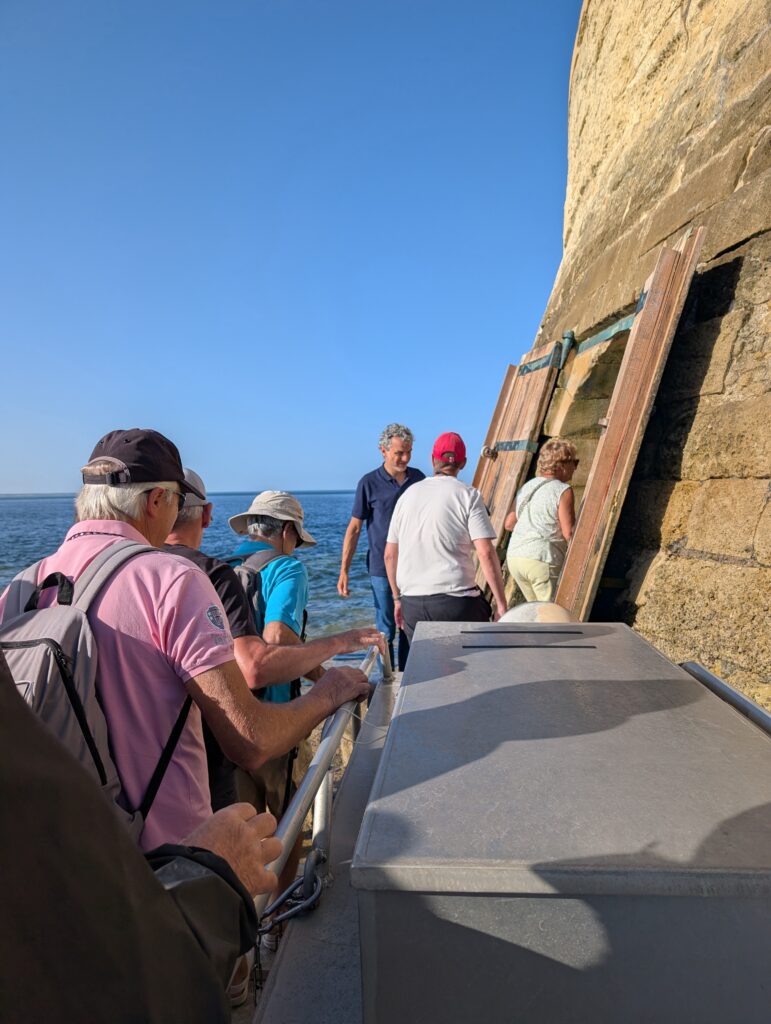
We walked up a set of stone stairs onto the deck circling the lighthouse. Staff quarters, the souvenir shop and a few other facilities were built into the outside wall. Following our guide, we went straight into the entrance and up the circular stairs. And found ourselves in the king’s bedroom. Our guide, Pierre, explained that the lighthouse was envisioned as the entrance to the Kingdom of France, at a time when English control of Aquitaine had ended.
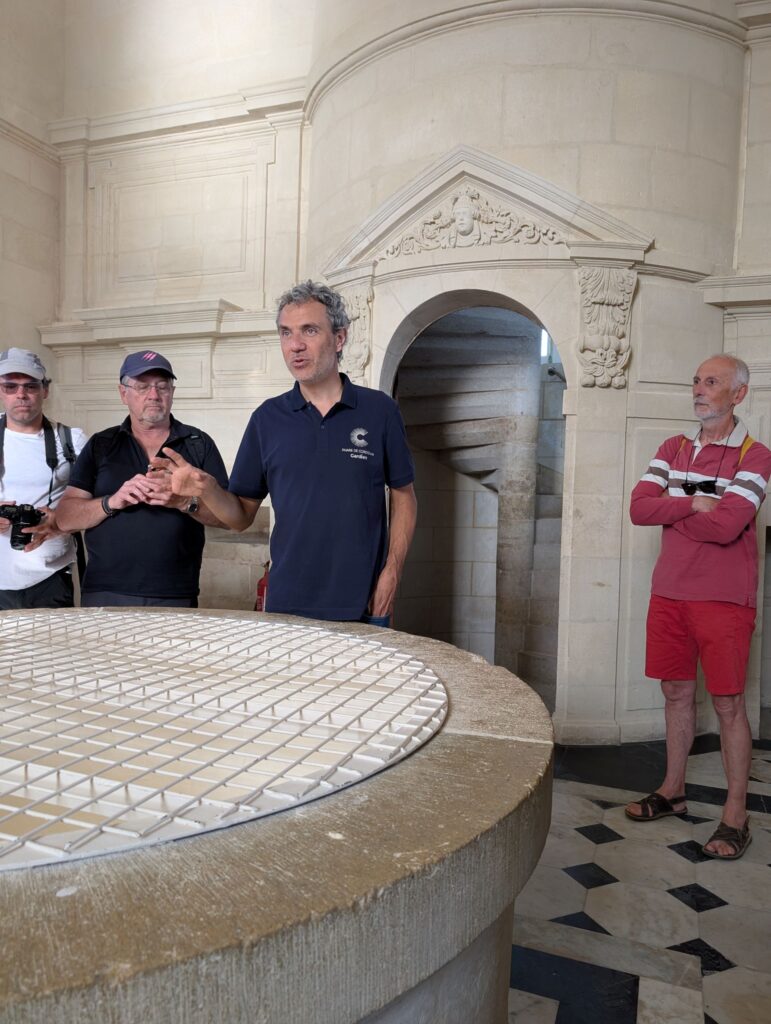
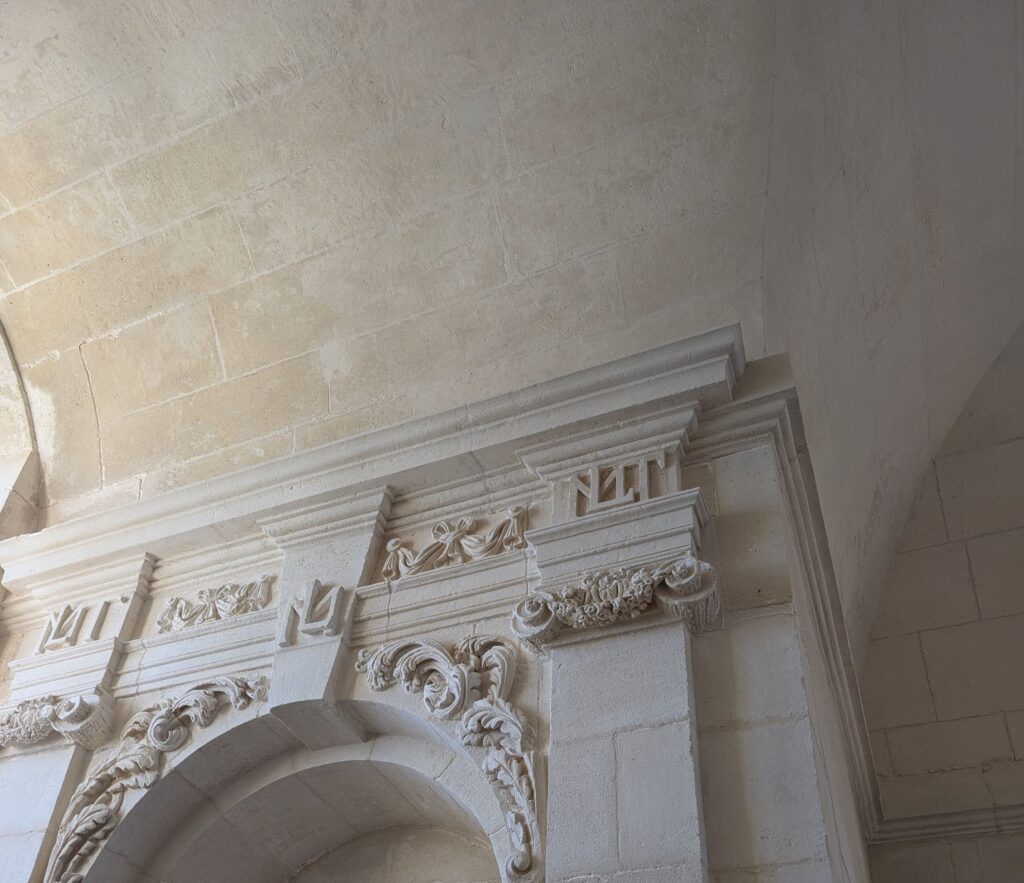
That’s why Cordouan came to be known as both the king of lighthouses and the lighthouse of kings. It’s also called the “Versailles of the sea,” though that seems a bit much. The initials of King Louis XIV and Queen Maria Theresa are intertwined in arches around the bedroom. They weren’t rubbed out during the Revolution, but Pierre said the busts of Louis and his successor, Louis XV, were removed. And the next level was baptized the Girondins Room, after an anti-monarchy group active in the legislative assembly.
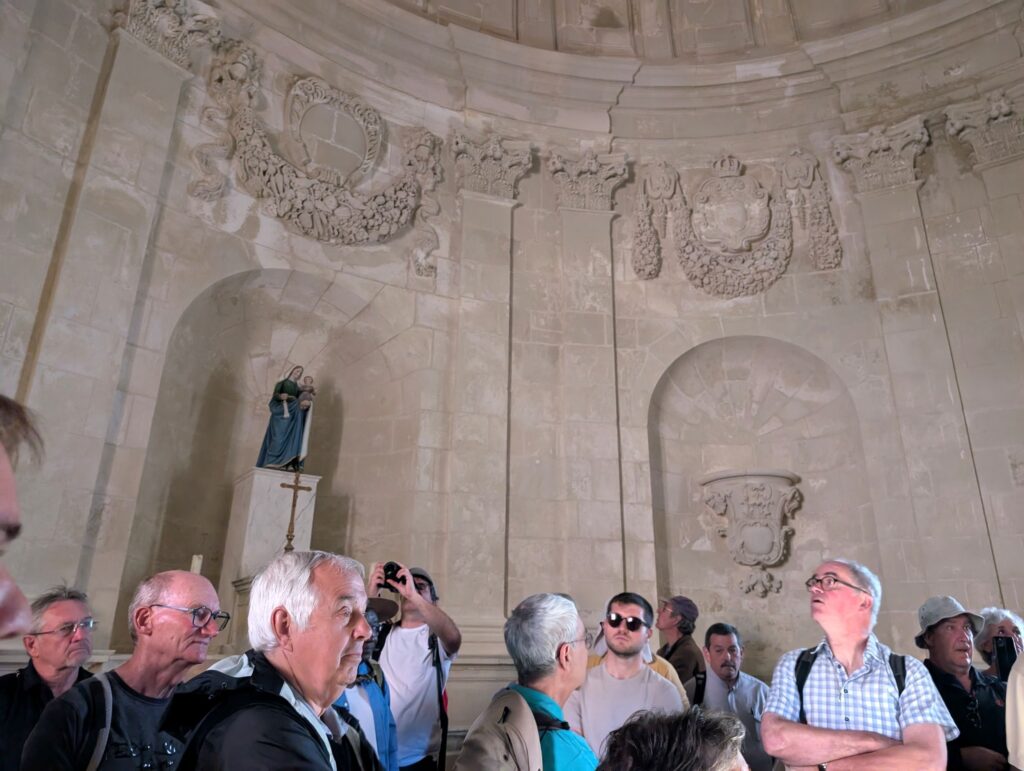
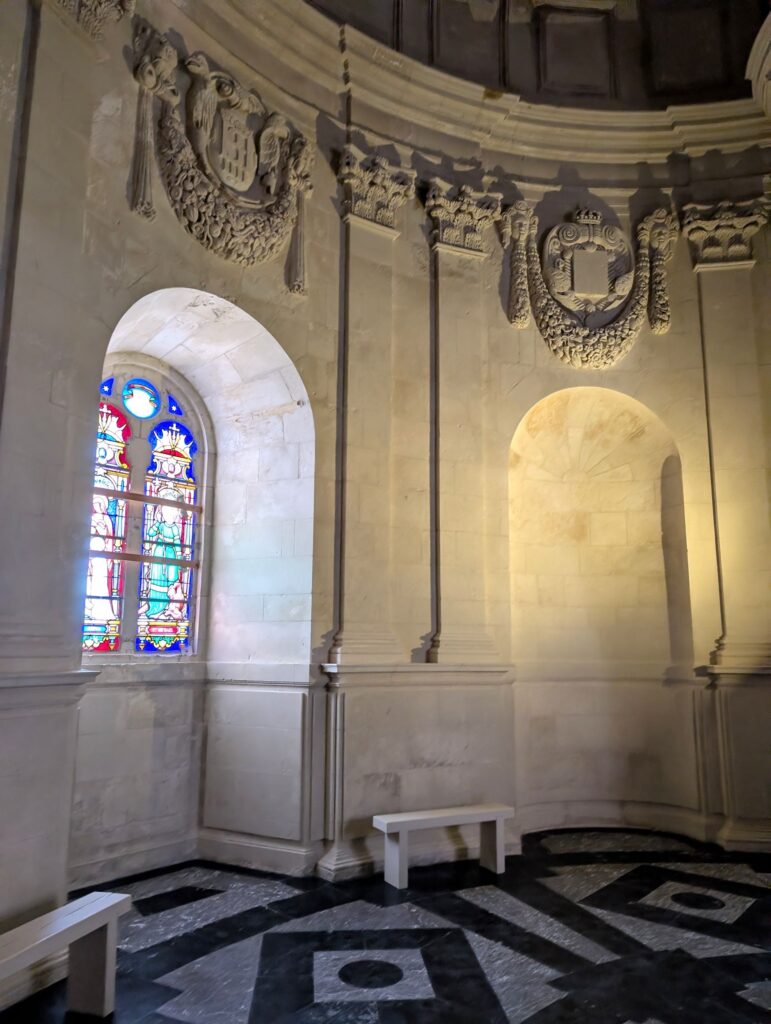
Even more impressive was the royal chapel, on the next floor up. Unlike the bedroom, this is actually used, Pierre explained, especially for local weddings and other celebrations. The guidebook says Henri IV insisted on a chapel to prove to the world that he had converted to Catholicism. I guess going there wasn’t part of the proof, since he never did. Neither did any other royal.
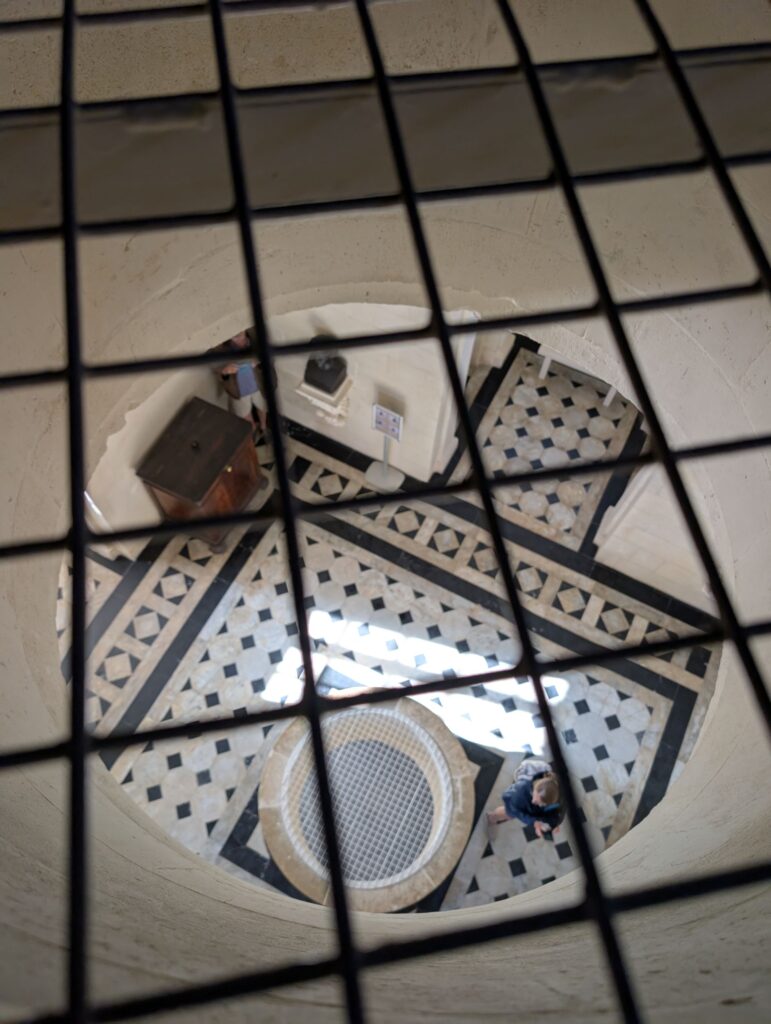
The entire structure is punctured by a big hole whose protective screens can be removed to winch supplies and equipment up and down.
Pierre said we might want to split up in two groups now to avoid crowding the summit, accessible in 168 more steps out of a total of 301. On the way up, we passed the log room, where the keepers watch the light and report problems.
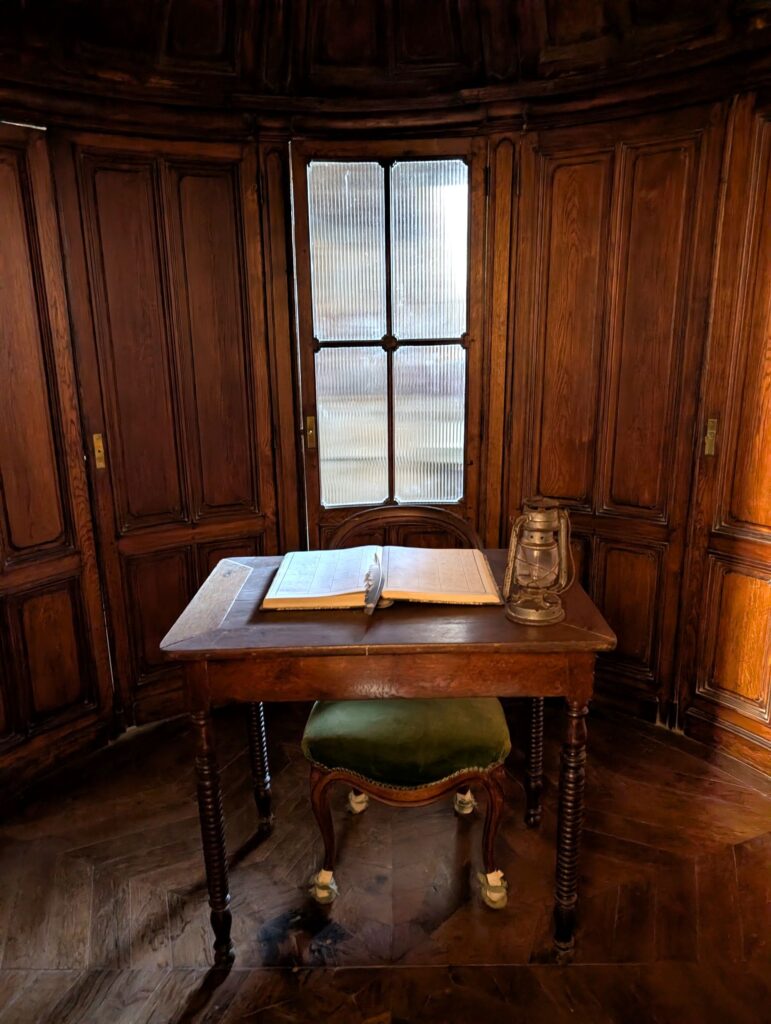
The gardiens don’t spend much time there now, Pierre said, since the light, like most these days, is entirely automated. If something goes wrong, backup systems kick in. And if it’s really serious, a team of technicians come from the mainland.
“Since you don’t work on the light, what do you do?” one of the tourists asked Pierre, a former history teacher.
“A lot of cleaning,” he smiled. “Look at all that teak, and the stone decorations, and the stained-glass windows.” The keepers work a two-week-on-two-week-off schedule and he seemed to really enjoy his job.
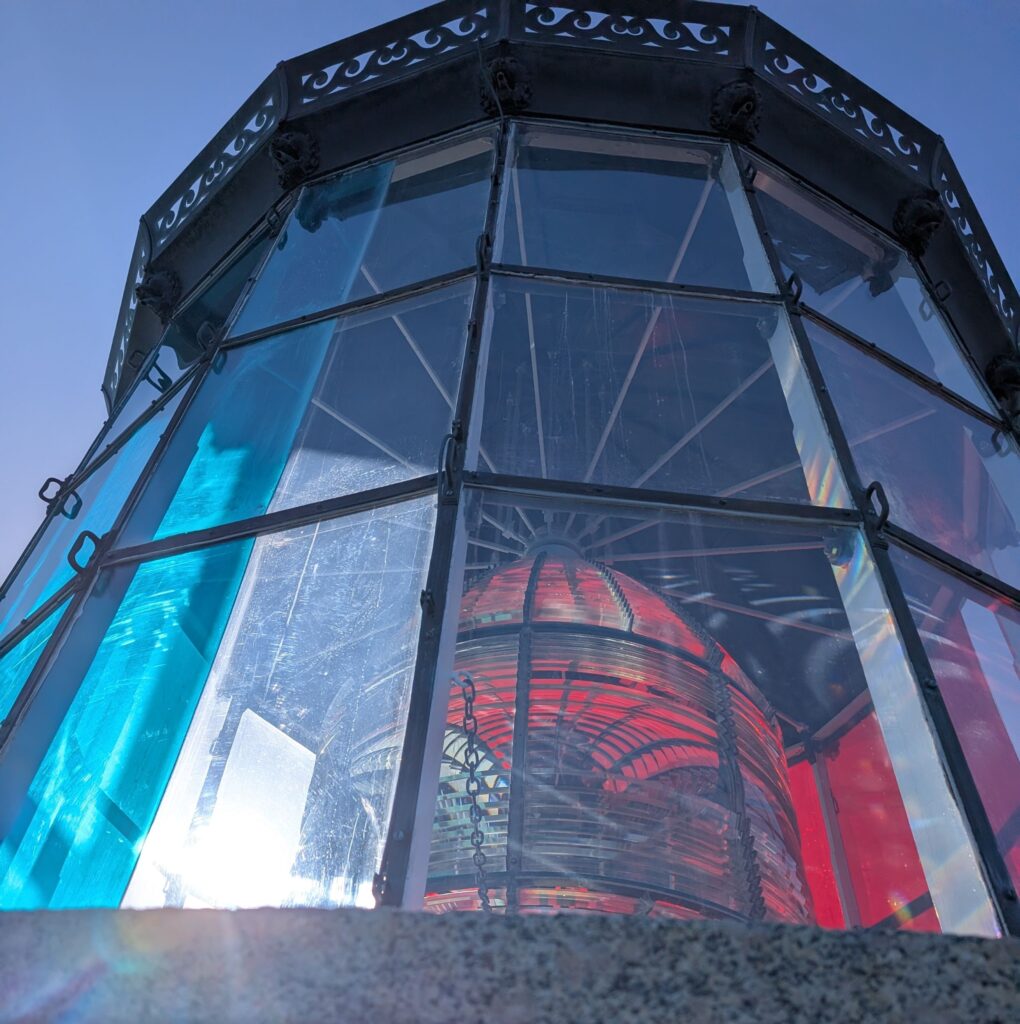
The top of the lighthouse gave us a good view of the light itself. Like almost all lighthouses these days, Cordouan uses a Fresnel lens, which makes the beam more visible. Invented by a Frenchman!
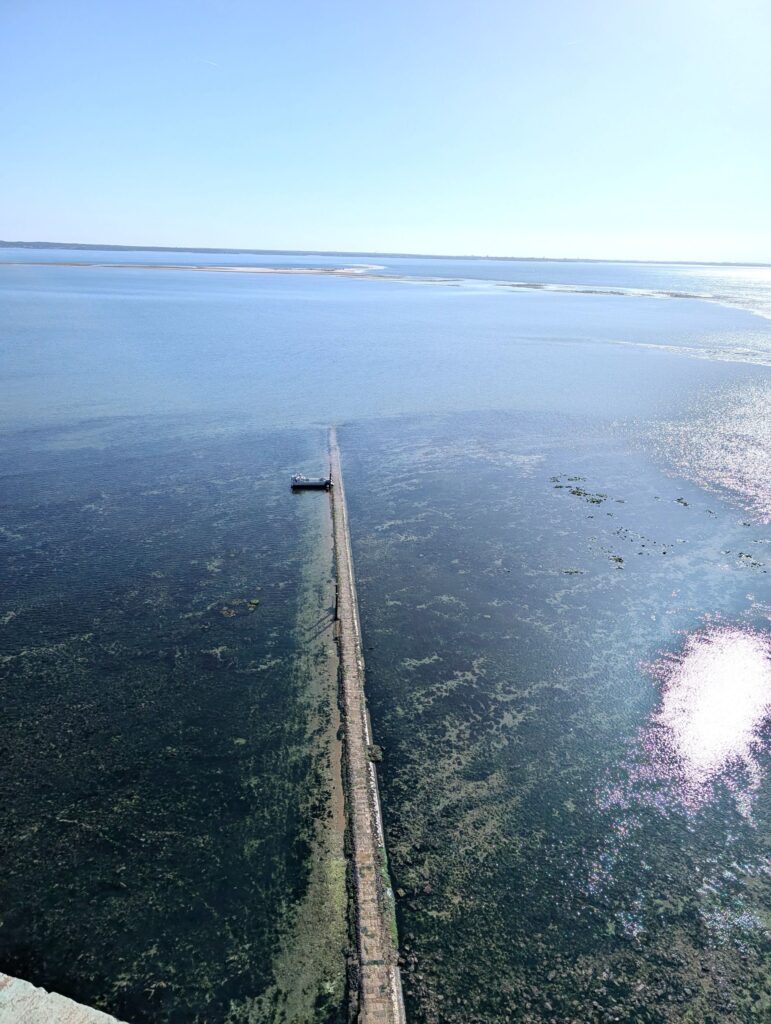
I don’t know how far the view from the top was, since I hadn’t had room to pack binoculars, but it was stunning. And it revealed how far the tide had fallen since our arrival: The stone pathway leading from the lighthouse was now entirely uncovered.
When I descended the 301 stairsteps I saw Pierre hanging around. This was a great opportunity to pursue my real agenda in coming here: A mystery-fiction publisher is seeking short stories to consider for a future anthology whose theme is lighthouses.
“Excusez-moi,” I began. “Je suis romancière, spécialité polars.” I went on to explain I wasn’t just a writer specializing in crime fiction but that I wanted to set a murder mystery here.
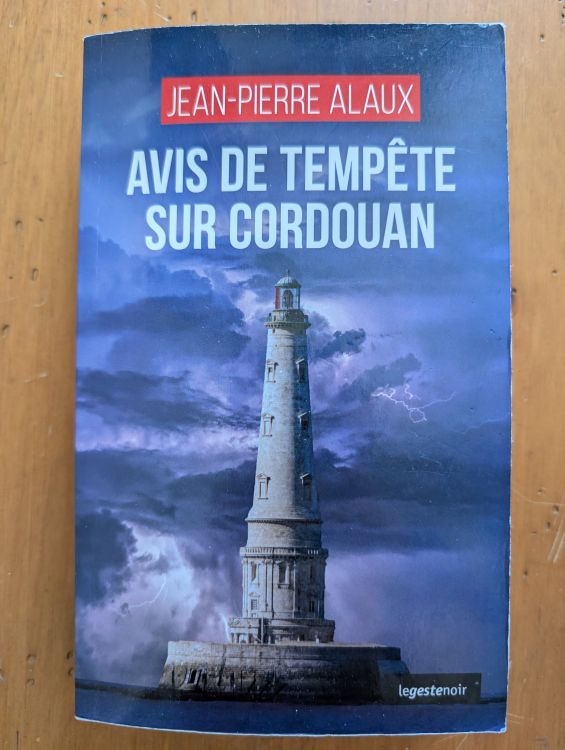
He brightened up. “There already is one!” he said. He went and got the book from his quarters. The title means “Storm Warning Over Cordouan.” I bought a copy at the gift store, but happily, the plot bears little resemblance to what I had in mind.
“Where would be a good place to kill someone undiscovered” I asked Pierre. He thought about it and suggested the former staff quarters on the lighthouse ground level, now unused because the newer rooms have more amenities. “Too easy to be seen,” I said.
“I’ve got it!” he exulted. He walked to a wooden door on the ground level and opened it. It was the equipment room: kayaks, nets, flippers—and several harpoons. Voilà. But wasn’t it kept locked? I asked? “We don’t always have time when it’s busy,” he said. Double voilà.
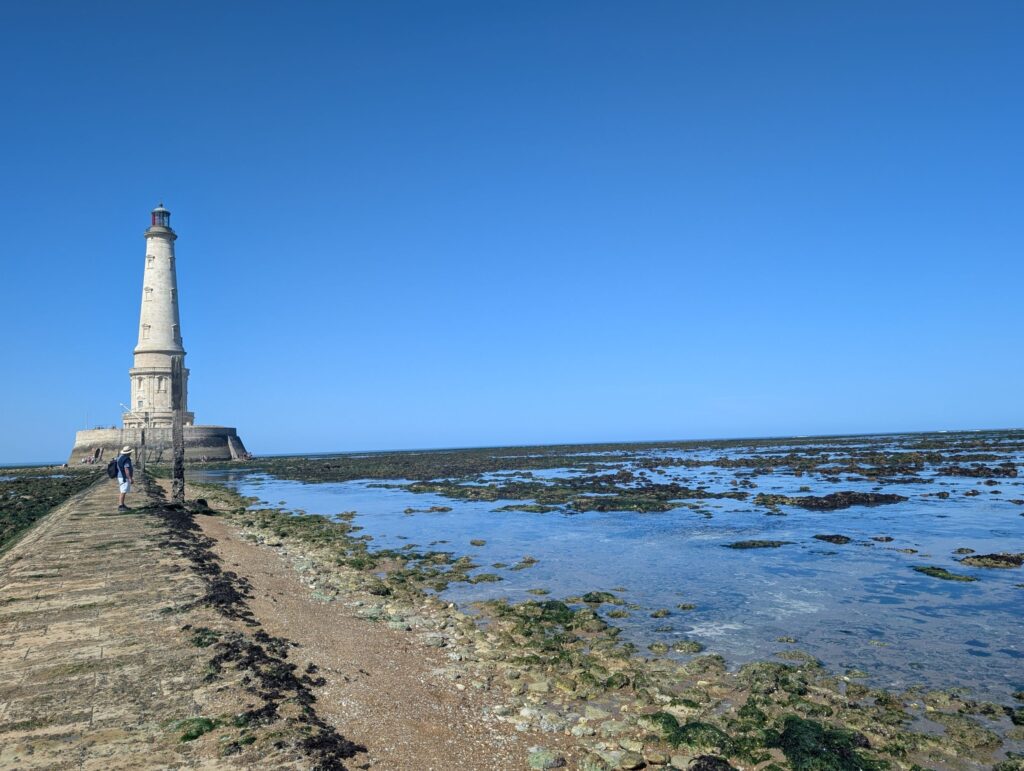
Time and tide wait for no tour group. We had to leave. This involved walking out to the end of the stone pathway, now fully exposed.
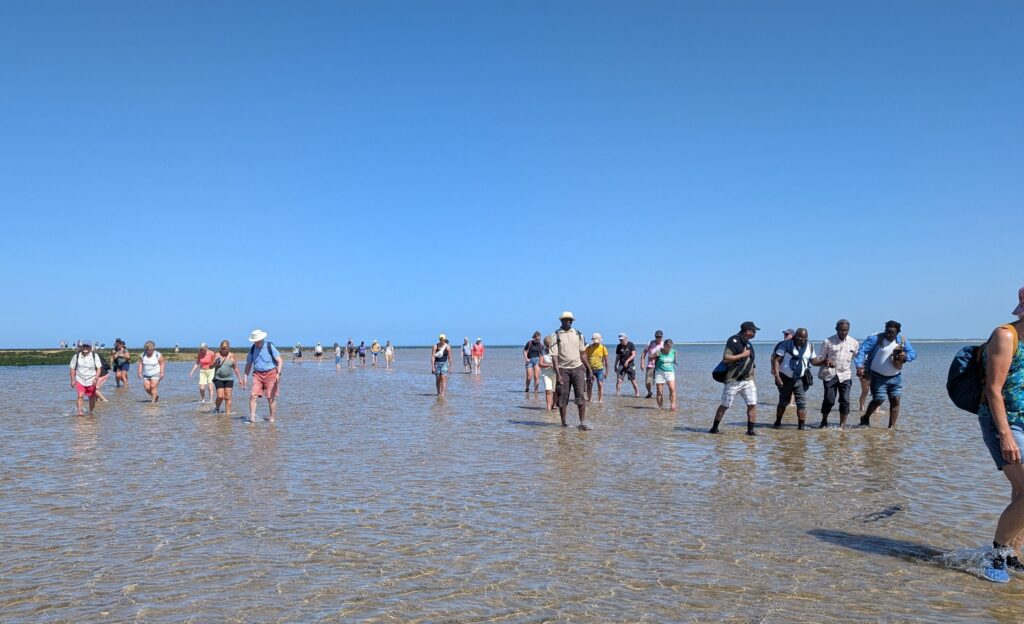
Then we put on our water shoes and walked about 10 minutes over the flats, the ocean lapping at our ankles.
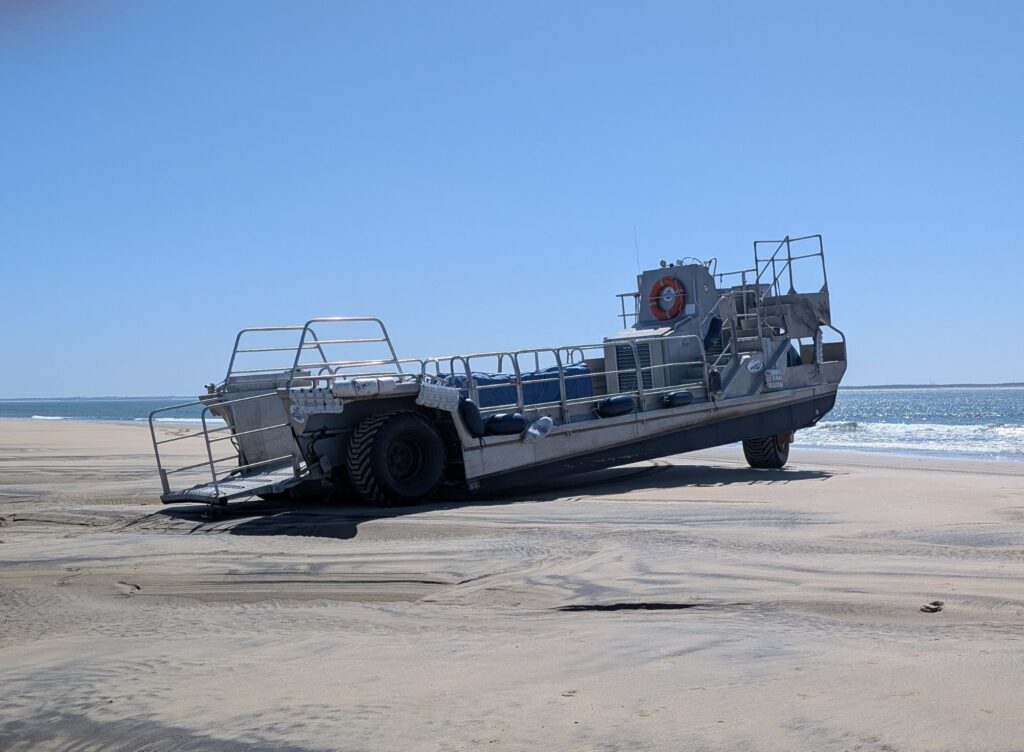
The shuttles were waiting on the sand. I saw how they could approach so close to the lighthouse at high tide: rubber tires.
As Cordouan receded, I reflected on recent budget-cutting talk about getting rid of the keepers—it’s the only lighthouse that is staffed year-round—and thus ending visits for tourists. If I were the Queen of France, I wouldn’t let that happen.
Would you like to be the queen of France?
Our best friends live full time in Gatteville le Phare. Gordon often talks about their lighthouse. It is the second tallest in France. For some reason I have no desire to climb all those steps but maybe some day I will. There is a lot of history in Le Cotentin. Perhaps you can do a story about “The White Ship” “La Blanche Nef” that hit the rocks off Barfleur/ Gatteville with everyone perishing except a butcher including the Heir to the English Throne William Adelin 25 November 1120. That was a bad time to be sailing across the channel I believe.
Fascinating! I’m so glad you had this adventure. Anticipating the story to come!
Thanks!
Totally fascinating adventure! I had no idea that the lighthouse would be so grand, and ready for a king’s visit. I think you should get your wish…. To be queen. Good luck with the mystery.
Thanks Warren! Queen Anne of Athens?
I love this description of your tour to Cordouan and can’t wait to read your mystery!
Thanks so much!
Nice! I would definitely read your lighthouse murder mystery, Anne! What a great setting!
Thank you!
Another fun photo essay! Thanks
Many thanks!
This is now my favorite of your posts! Thank you, Anne! Can’t wait to read the murder mystery, though I hope you put the body somewhere else now that we know two possible stashes.
Thanks Mary Lou! Who knows what will happen when I actually start writing the story?
I see a charming and intriguing crime mystery brewing!
I hope so! Many thanks.
Terrific post. I knew nothing of Cordouan — zero. What a great tale you’ll have, including the tide-dependent comings and goings.
Many thanks!
Fascinating Anne. Thank you.
You are so welcome!