
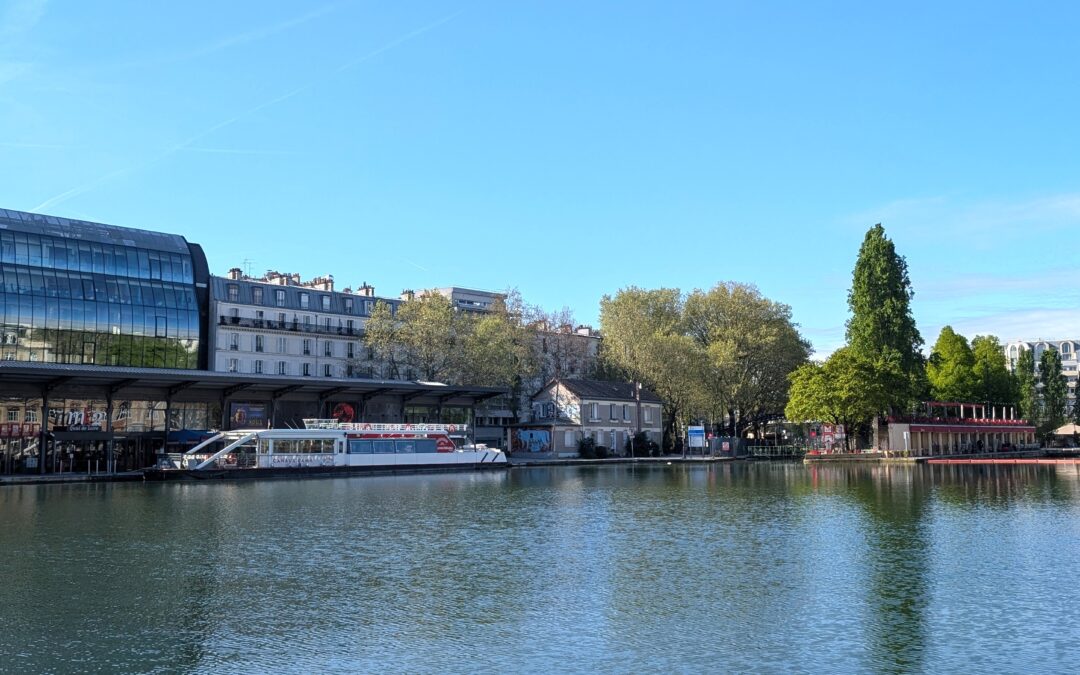
I like to explore the outer edges of Paris to see the new, the modern, the unexpected. Walking along the Canal de l’Ourcq gave me that, and also some Paris history.
The canal starts in the 19th arrondissement at Bassin de la Villette, which collected water from the River L’Ourcq for use in Paris even before there was a canal. The river also had been used—since 1415!—to transport grain.
It was Napoleon Bonaparte who commissioned the canal, though it wasn’t completed until 1825, after his death. To pay for it, he imposed a tax on Parisians’ wine, or so it is said. The word Ourcq means either little river or windy river in Gaulish, to give you an idea of how far back this goes.
I usually do my walks alone, so I was delighted when Francie came this time. It also meant I could get a photo of me that wasn’t a selfie.
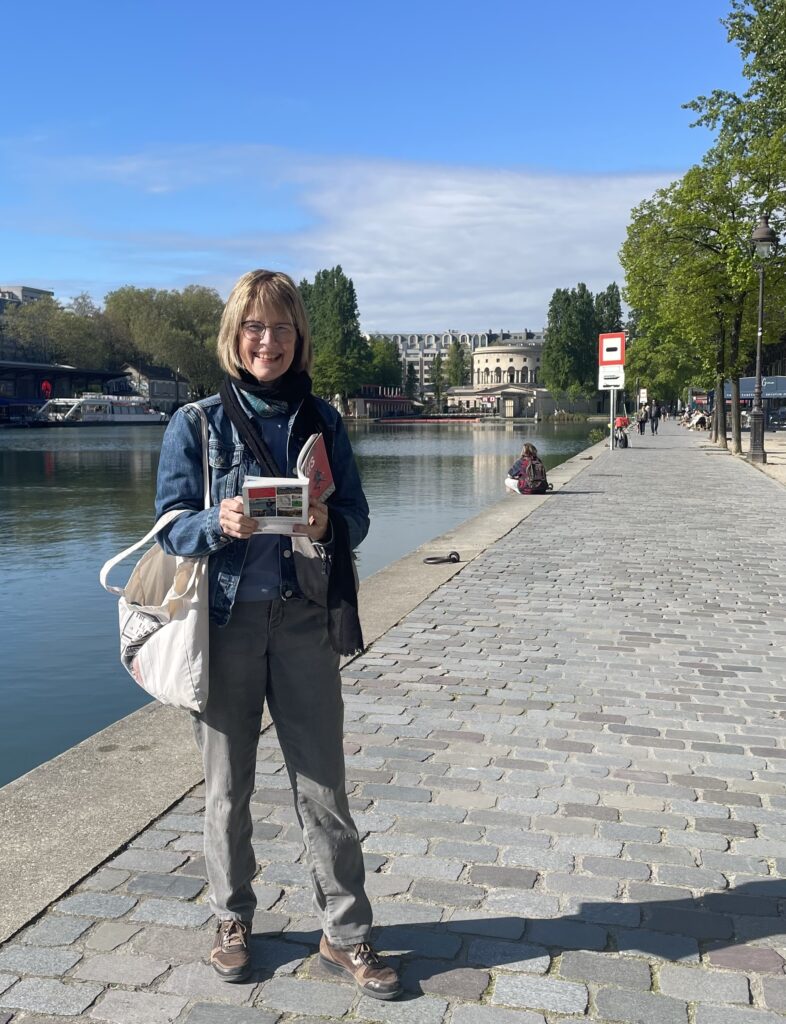
Photo: Francie Plough Seder
The guidebook I used was Nicolas Le Goff’s “The Other Paris,” a reliable friend that has taken me to many new places. We started by walking around a pre-Revolutionary pavilion, which housed excise-tax collectors monitoring the river traffic. It now houses a popular café, La Rotonde. You can see it behind me in the above photo.
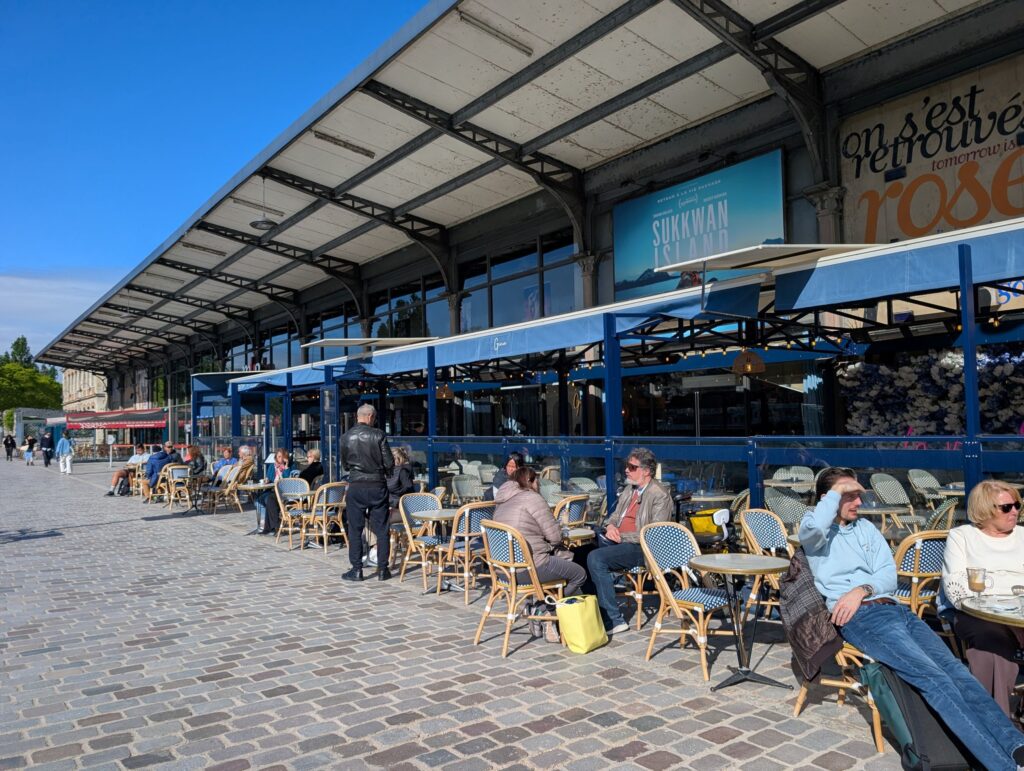
Moving to the present, we walked by a movie theater whose twin was on the other side. According to Le Goff, a shuttle crosses the river between them in case you wanted to see movies at both. The theater also boasted a nice café that people were enjoying even on this chilly day.
We crossed a footbridge over the basin to come to the Paname Brewing Company, a café on the river located in a former wine and grain warehouse. Paname is slang for Paris, perhaps because of a Panama hat craze in the early 20th century. The company makes actual local craft beer. I couldn’t figure out the building across the river, the one that seems to be covered in wicker, but my friend James enlightened me. It’s a hotel and youth hostel, and the wrap is actually aluminum.
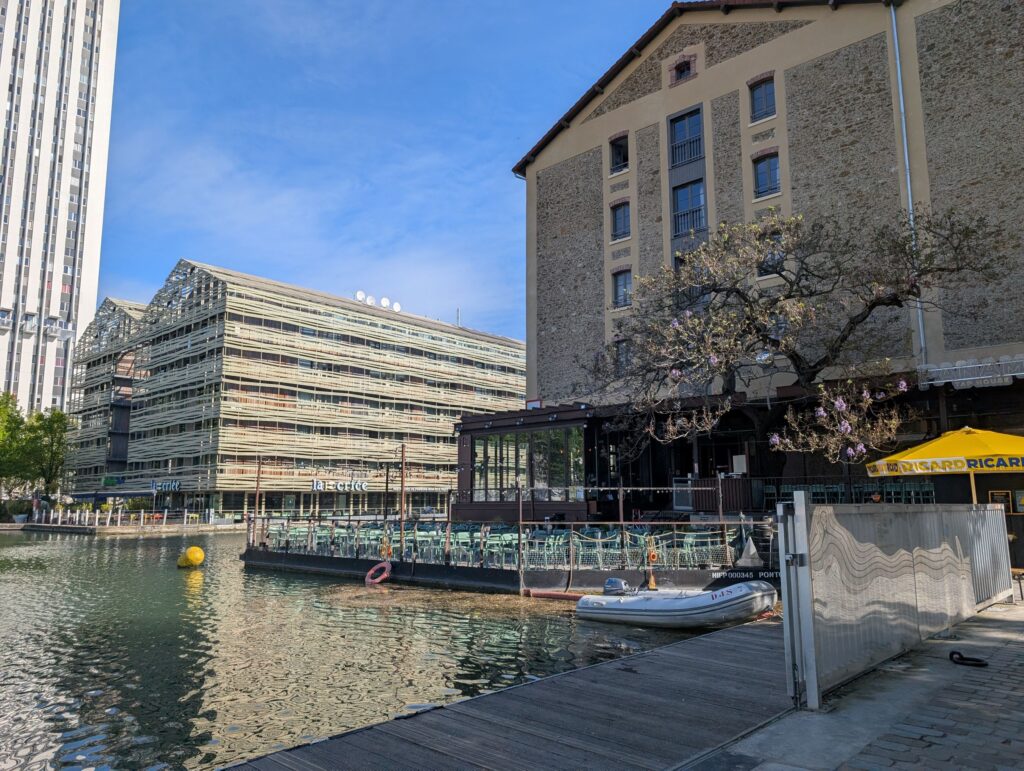
Also in the Paname building: A scull and kayak rental. The gentleman who spoke to us confirmed what Le Goff said: As long as you are a resident of Paris you can sign up to use either kind of boat, at a very reasonable price.
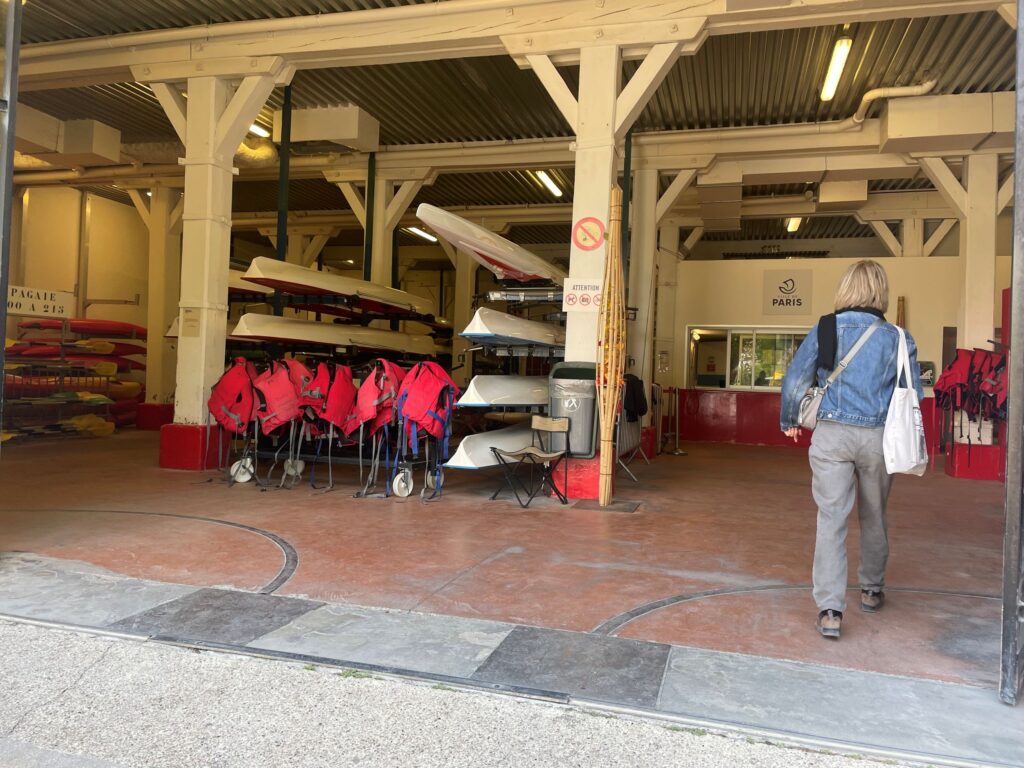
Photo: FPS
We walked back over the canal on the last drawbridge in Paris, though we didn’t get to see it lift to let boats in. But on the other side we saw a sight that set our hearts racing: An old church. THIS we could analyze.
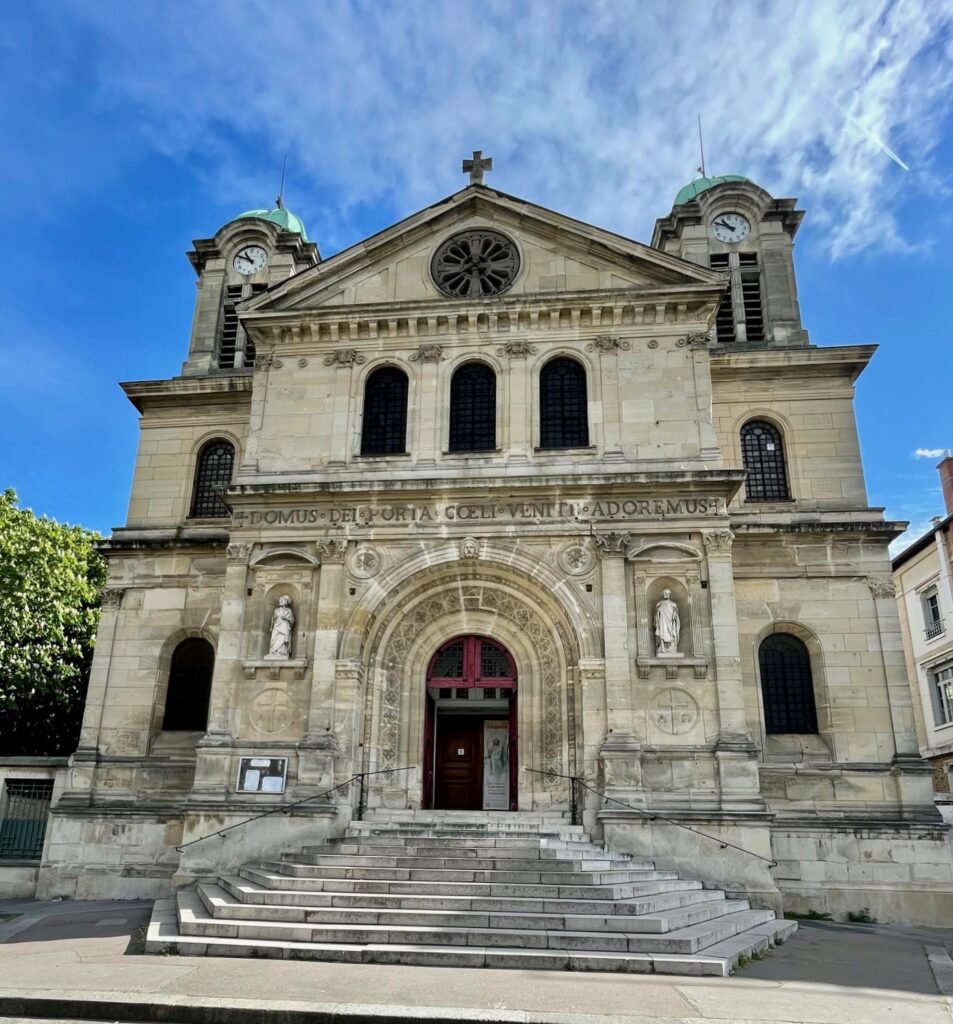
Photo: FPS
Saint-Jacques-Saint-Christophe de la Villette is a neoclassical church built in 1844, in the style of a basilica. Apparently there are some very interesting features inside, such as the baptismal font, but the church was closed that day.
Some of the sights we saw were neither gentrified nor charming, chief among them the bridge we crossed next. It had been part of the Petite Ceinture, the railway that encircled the entire city, but clearly nothing had changed since that line was closed in 1934.
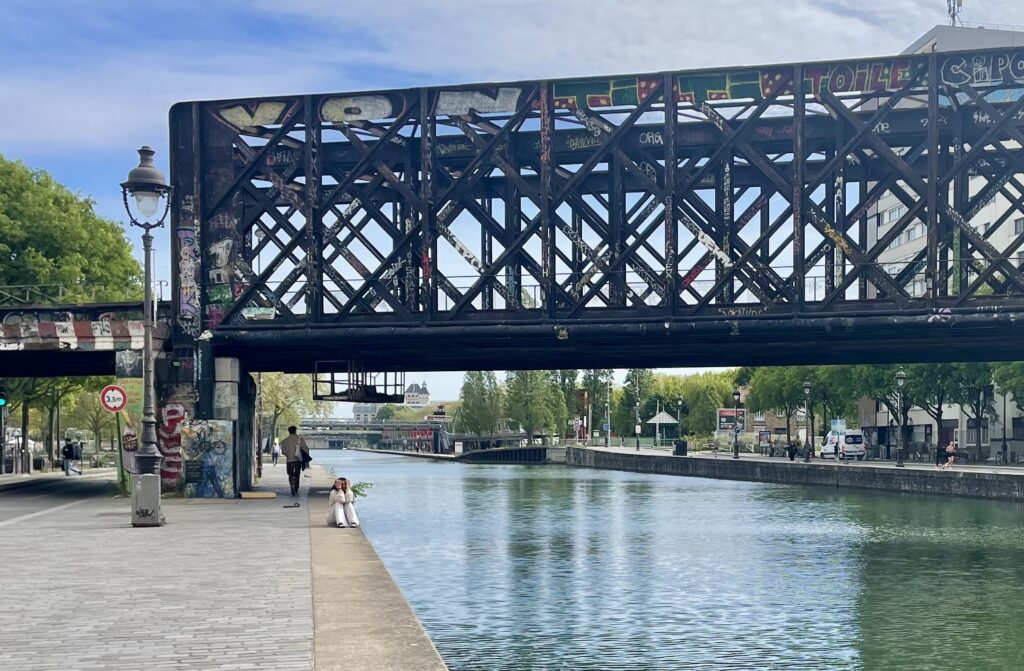
Photo: FPS
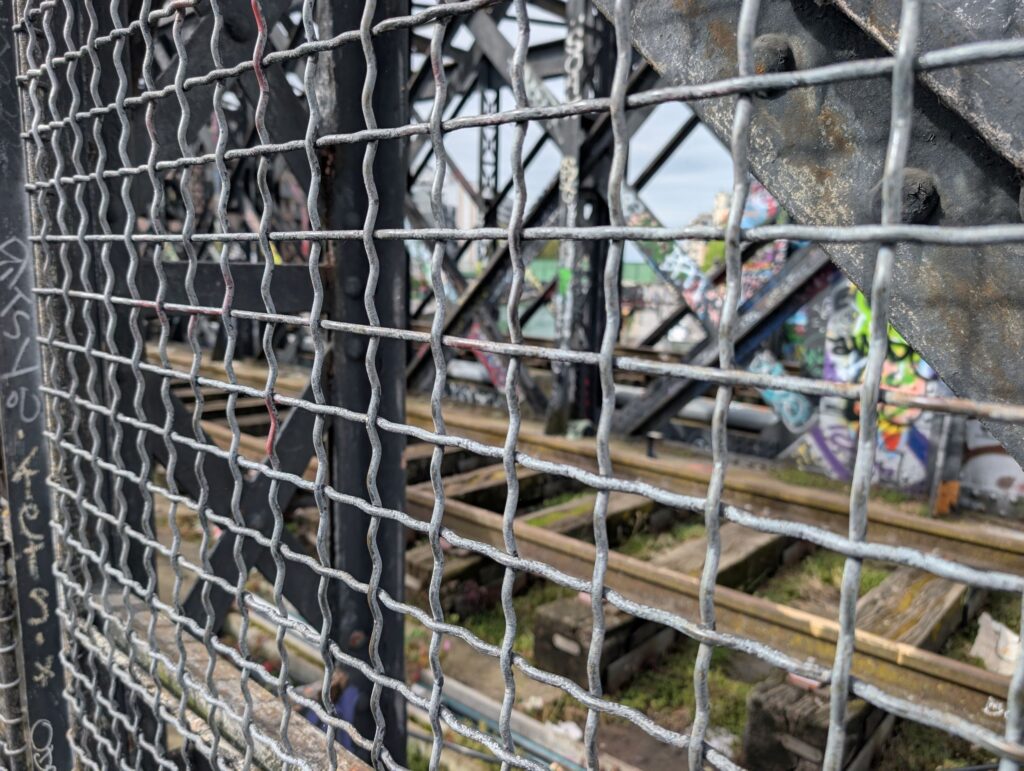
We skipped one of the big attractions on the walk, the Parc de la Villette, because we had both been there many times, starting when our kids were little. But I didn’t know until I read Le Goff’s book that the 55-hectare complex was built on the site of Paris’s slaughterhouses. It now is home to a stunning concert hall, a music museum, a science museum with a great children’s section and many other features.
Including a popup blue cube that caught our attention from the other side of the canal.
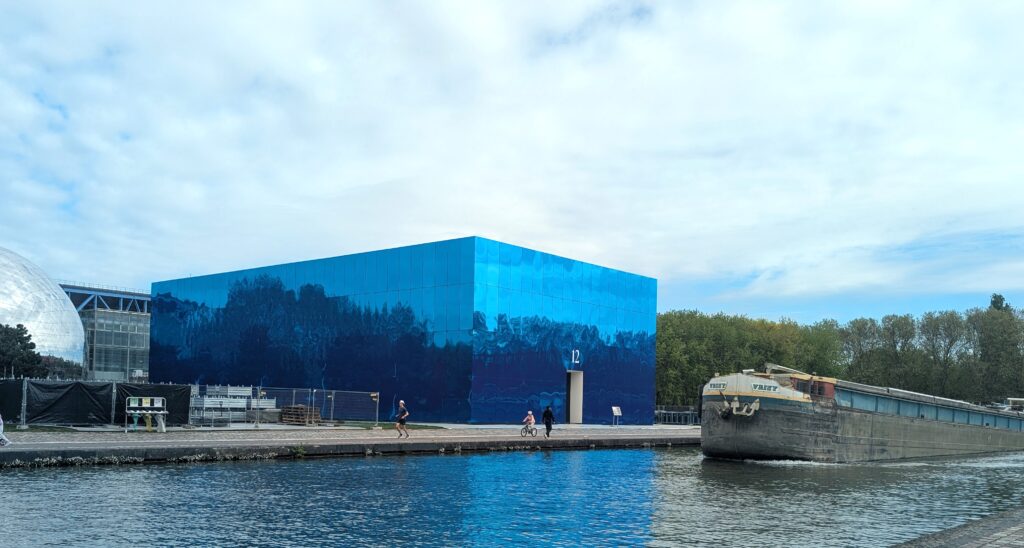
As the photo shows, barges still ply the canal, and we saw several.
Just after the parc, we crossed under the Boulevard Peripherique, the six-lane beltway that Paris’s new mayor says he wants to turn into a green space.
Now we were out of Paris and in the suburb of Pantin. Our first sight was graffiti artists—or were they street artists?—at work.
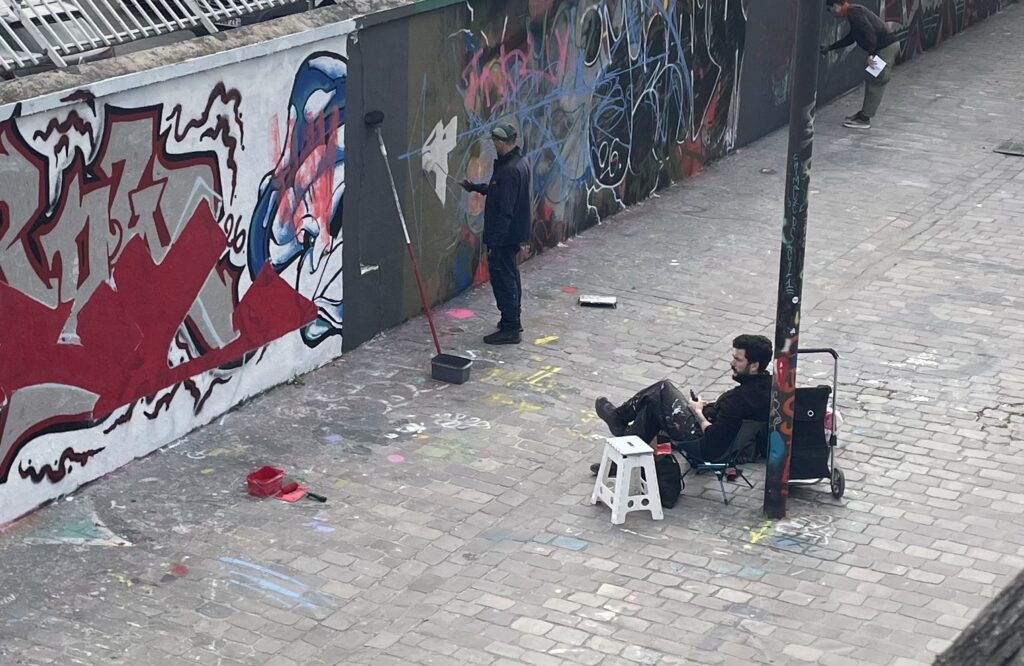
Photo: FPS
We were in industrial territory. On our side of the riverbank was a loading facility for cement company Lafarge. Lafarge, one of the biggest companies in France, is now a symbol of corporate accountability. Last month, the ex-CEO and seven other defendants were convicted and sentenced to up to seven years in prison, plus fines, for financing terrorism. They had paid bribes to ISIS in Syria so it could continue operations there. They are appealing.
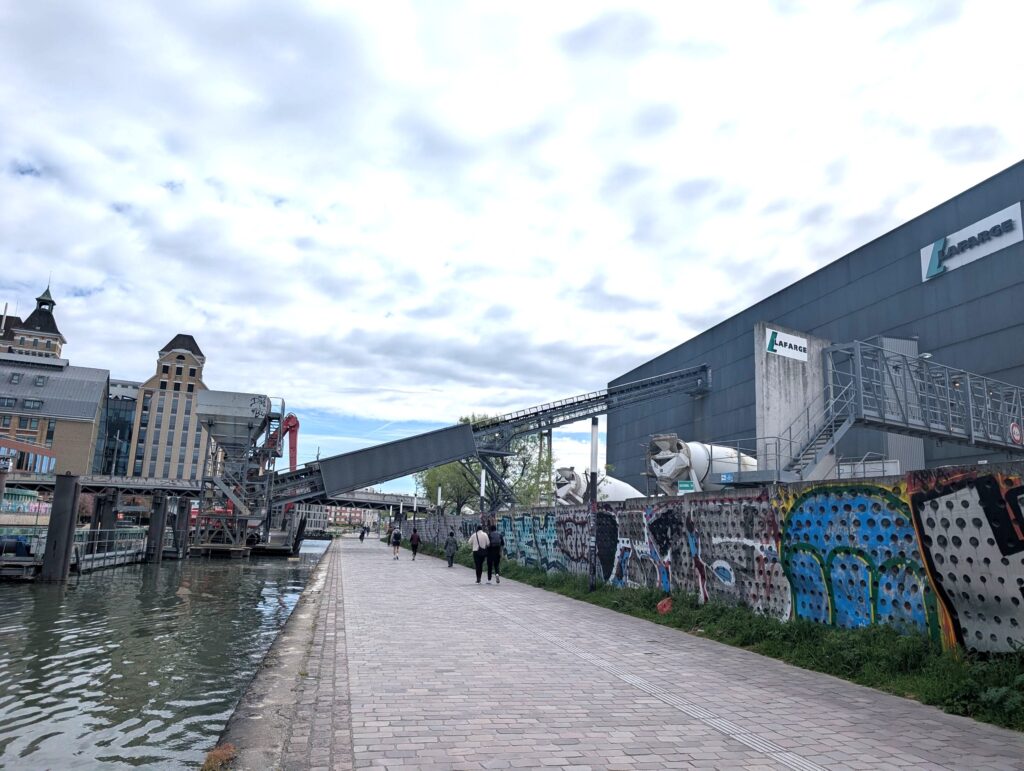
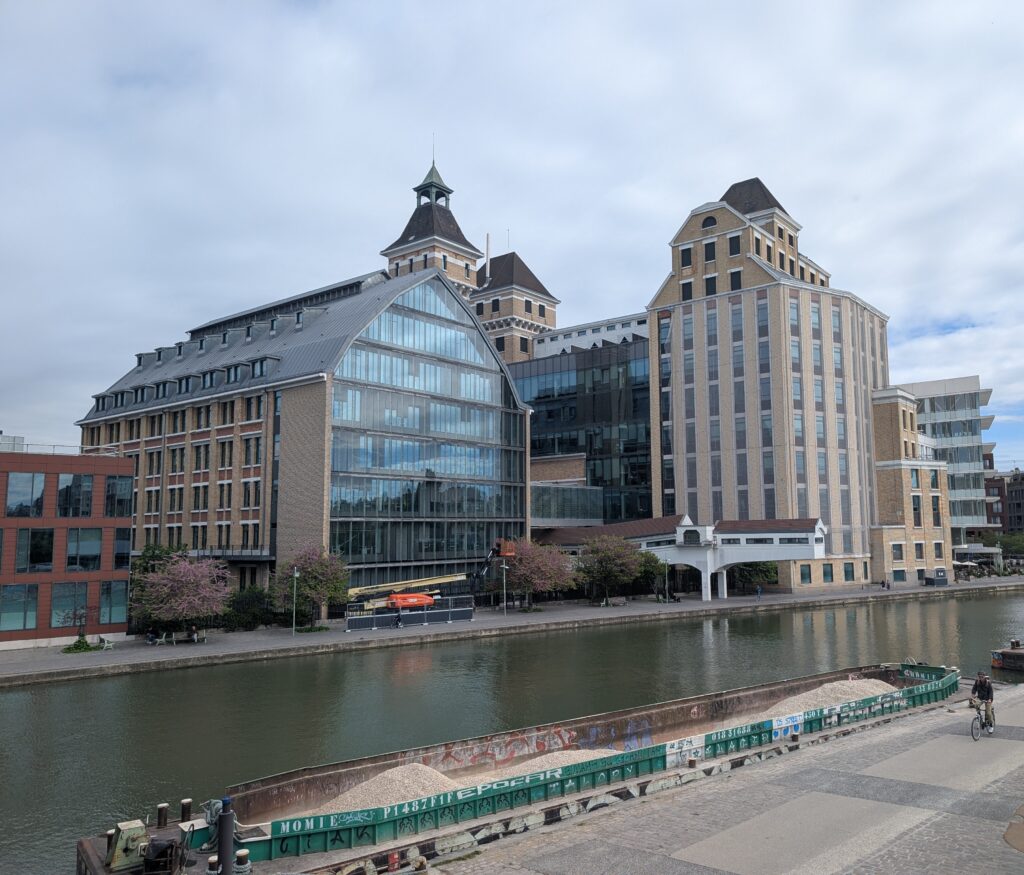
Across the river was an interesting housing-and-office complex built from two giant flour mills. (Historical photos are in the link.)
Note the loading chute.
And then it was time for brutalism. Brutalist architecture, big in the 1950s, is blocky, harsh and made of concrete.
There are two examples along the Canal de l’Ourcq. We didn’t make it to the housing development all the way up in Bondy but we got a good look the National Dance Center. Unfortunately, it was undergoing a complete renovation. The silver lining: It looked even more brutal.
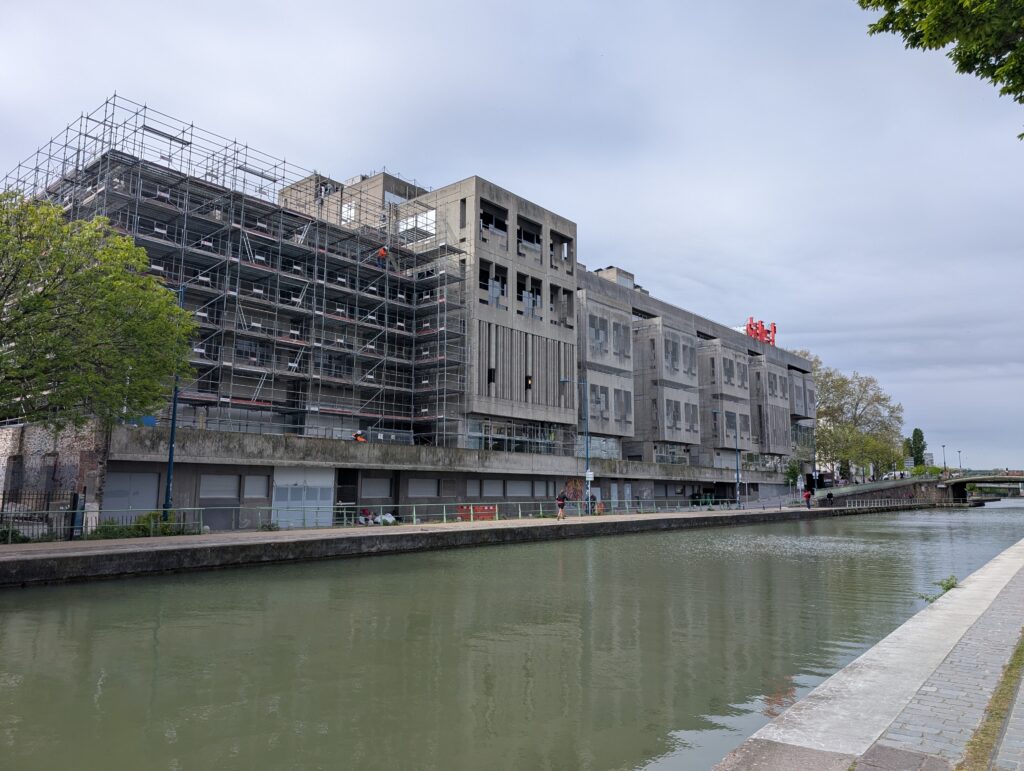
My friend Jane and her friend Julie had taken this walk a few weeks before during a visit to Paris. The renovation wasn’t visible then.
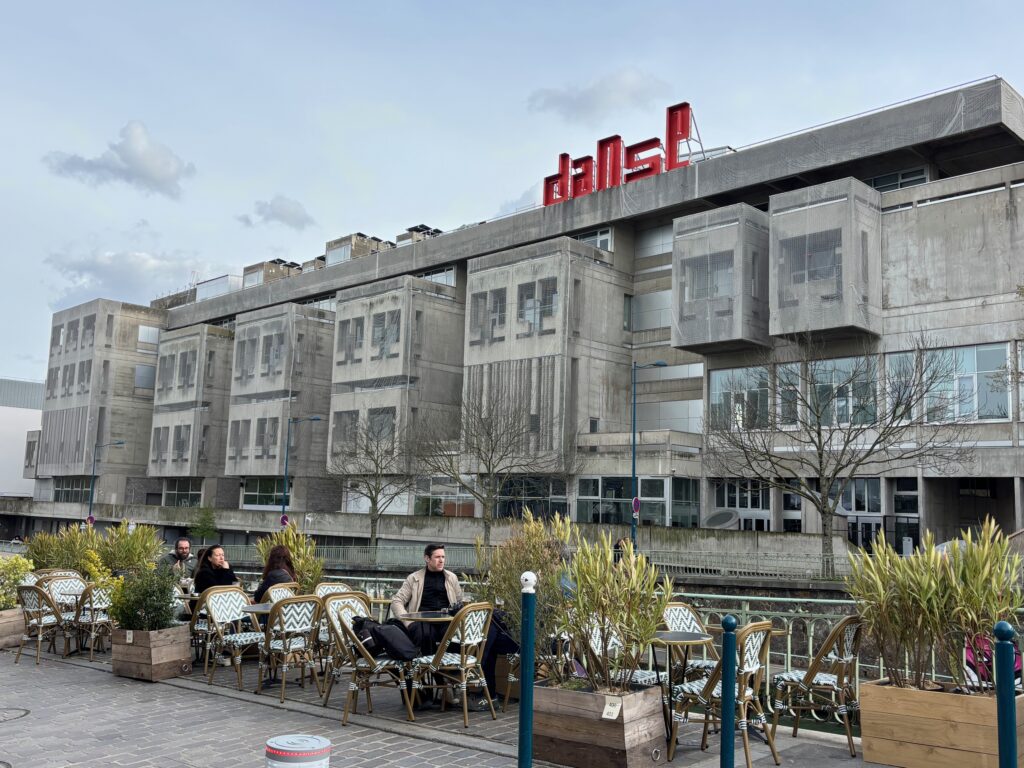
Photo: Jane Culbert
They also were treated to something you don’t see often on the canal: a recently caught fish, even more recently than the ones at the market. Jane reports that this young man was delighted with his success. The Canal de l’Ourcq yields all kinds of treasures.
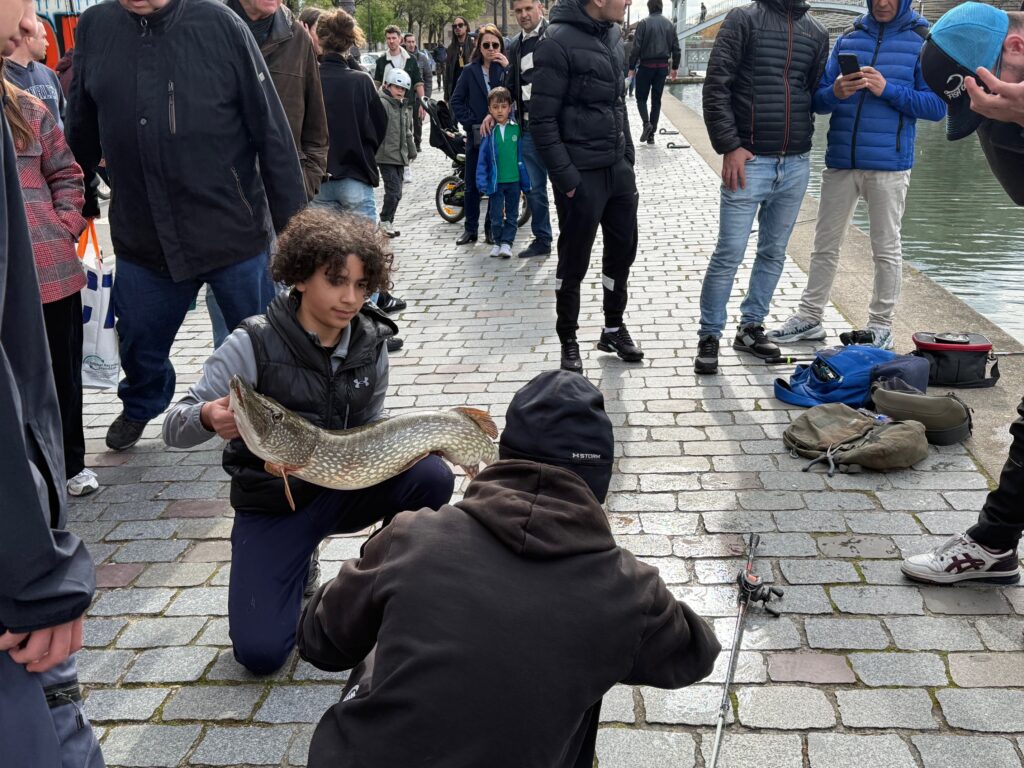
Photo: JC
Fascinating photo essay off the usual path!
Many mercis!
My legs are weary! But your tour was stimulating.
Next time I see you, please pronounce
Canal de l’Ourcq
Merci,
Roger
Thanks so much, Roger!
A most interesting “read”. Thanks , Anne
Many thanks, Joan!
Hi Anne,
Thanks for sharing this article – looks like you’re having a great time exploring some of the lesser-known parts of Paris. Great photo of you, by the way.
How amazing that you and Jane C. have explored the same area, just a few weeks apart. The Parc de Villette also looks fabulous.
Bruce and I just got home after a week in London, visiting Rachel’s family. All is well, and little Ollie is an adorable two year old! How long will you be inParis? Is Charlie at home in Staunton?
Let’s do a video call with Jane in the next couple of weeks! love, Anne H-S
Thanks, Anne! I confess I got the idea from Jane, and was delighted to see it was in my guidebook.
Hi Anne!
I love these blogs you create!
Thank you!
Mary Jane Elliott
Thanks so much, Mary Jane!
Nice. When my knee recovers …
Deal!
Anne, this was riveting and so beautifully written — and photographed. What a journey of discovery, on foot no less. For someone (that would be me) so confined by experience to this country, it’s downright wondrous to take in the long, deep history of Paris that presents itself on a walk. Thank you for sharing this. Lots of love to you.
Dale, that means so much to me, many thanks.
Huge thanks for a fabulous trip I doubt I would ever be able to take
Stay well and be happy
I’ll take you! You just have to come to France.
Thanks for this post. Will add this walk to our to do list for next time. Last visit we walked the entire length of Canal St Martin!
Regards.
Gene
Thanks so much, Gene!