
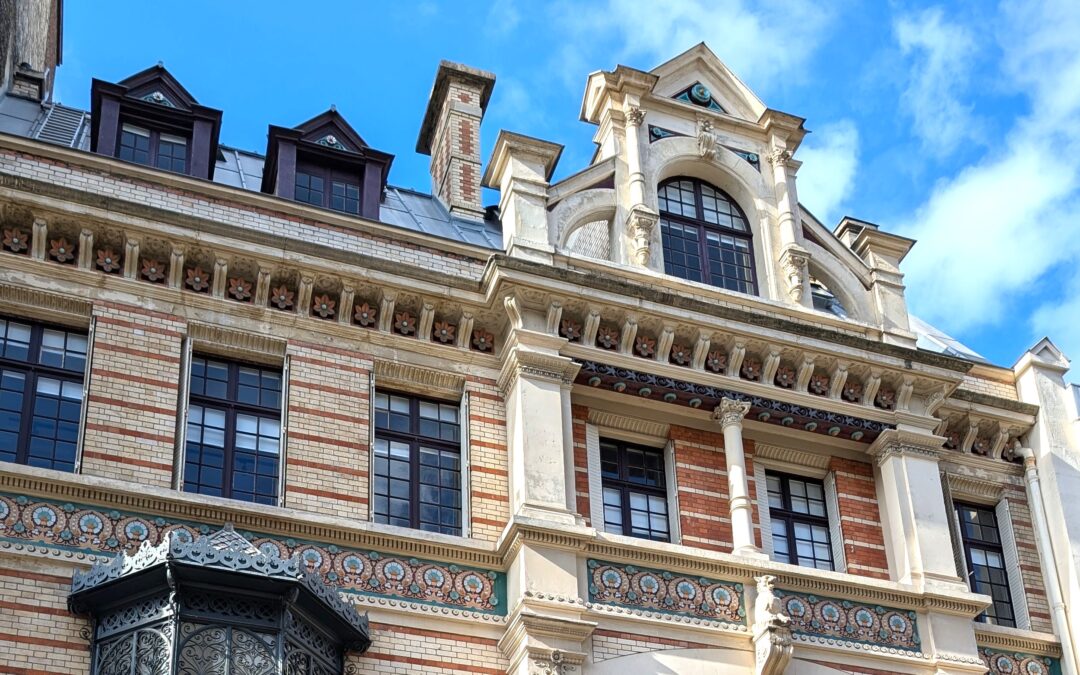
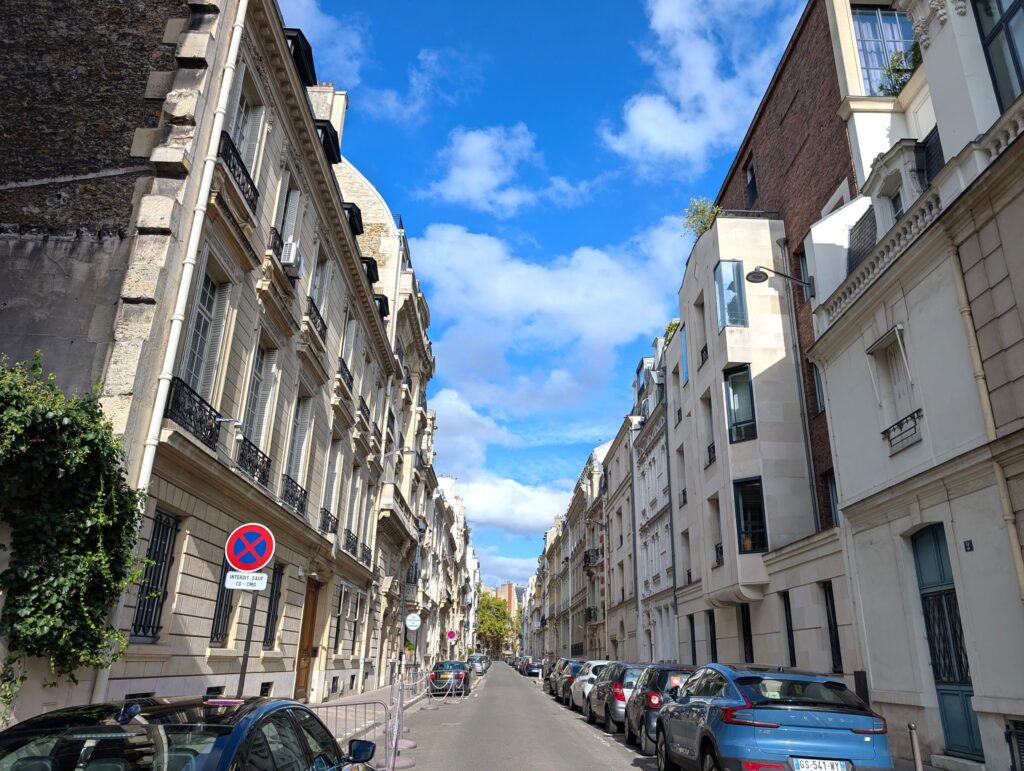
Anyone who thinks Paris is nothing but broad boulevards, cream-colored stone buildings and iron-filigree balconies should visit the rue Fortuny.
It’s a small street in the 17th arrondissement, north of the Etoile, running between the avenue de Villiers and the rue de Prony. You won’t see it in the standard tourist guidebooks or web sites, but its concentration of Belle Epoque architecture is unequaled anywhere else in the city. Just as important are the many France’s leading cultural figures of the time who lived here.
The rue Fortuny always reminds me how so much of what makes Paris Paris is kept behind closed doors or high walls. The Eiffel Tower and the Arc de Triomphe are meant to be seen, certainly. But what of the government ministries that can only be visited once a year? Or the huge gardens visible on Google Maps behind monasteries or convents or even homeless shelters. Or even the dinner-party guest who says nothing about himself the whole evening? You have to dig to find the real story.
It took a bit of research to learn that no. 35 was built for actress Sarah Bernhardt by architect Nicolas-Felix Escalier in 1876, at the height of her fame. It was her sculpture studio; she lived at no. 37 with eight servants, various family members and some pets until financial pressure led her to sell in 1886. Sadly, no. 37 was torn down in 1956 and the 1950s replacement building will not be pictured here. I hope “La Divine” could enjoy that nice balcony at no. 35.
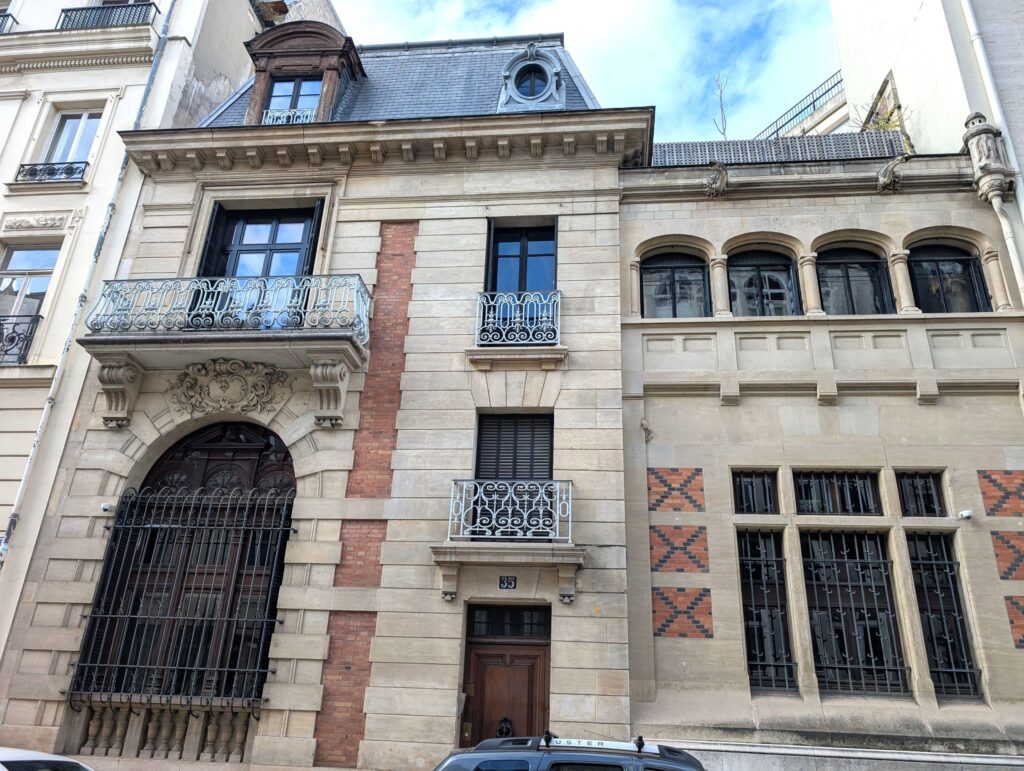
The houses on the rue Fortuny were built just as the Baron Haussman was finishing his redesign of the principal axes of the city, tearing down swaths of Paris to build the wide boulevards and homogenous buildings that even now embody the City of Light.
The overhaul opened up new sections of the city, in particular, Plaine Monceau, covering a chunk of the western half of the 17th arrondissement north of the Etoile. A hunting ground before the Revolution and farming territory after, the Monceau area was developed by Eugene and Isaac Pereire starting in 1850. By 1876, 16 years after the area was annexed by the city of Paris, houses were sprouting on the rue Fortuny (itself named after a Catalan painter, Mariano Fortuny y Marsal.)
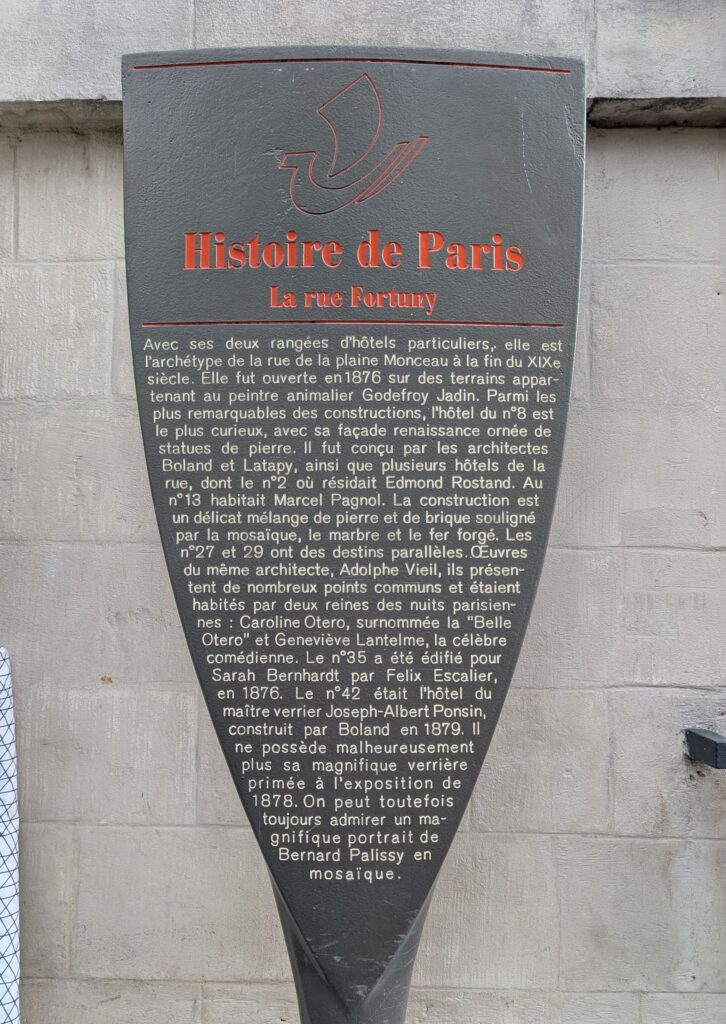
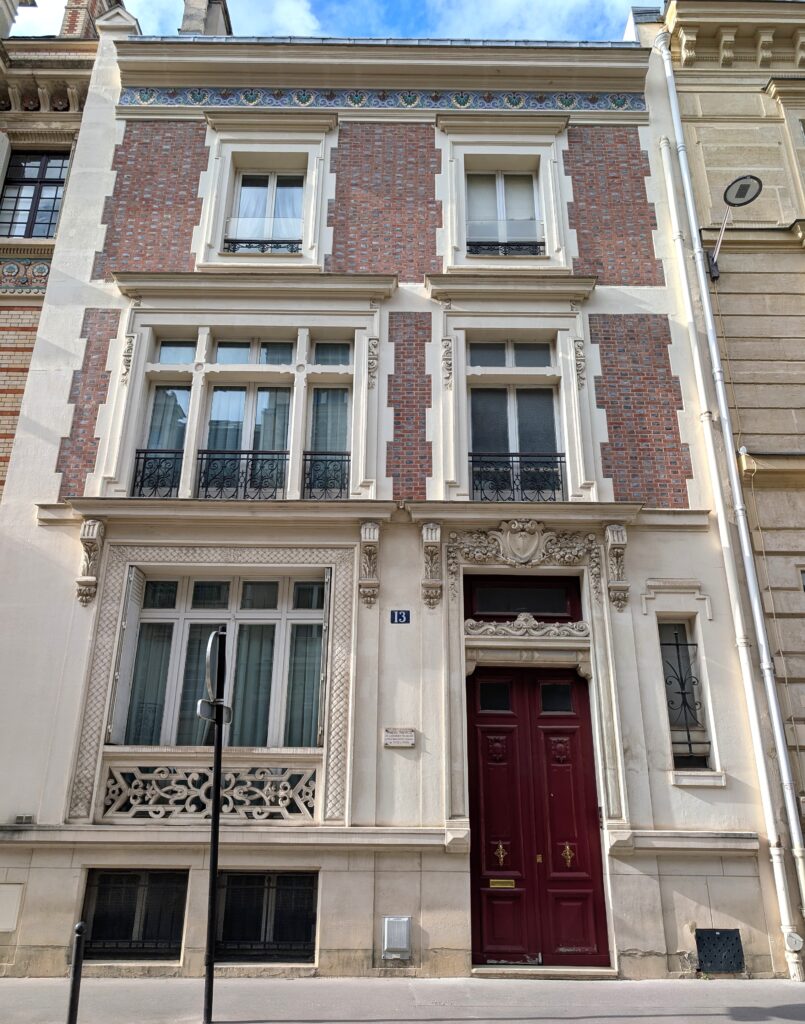
No. 13 was occupied at different times by painter Paul Vayson and, much later, author and filmmaker Marcel Pagnol.
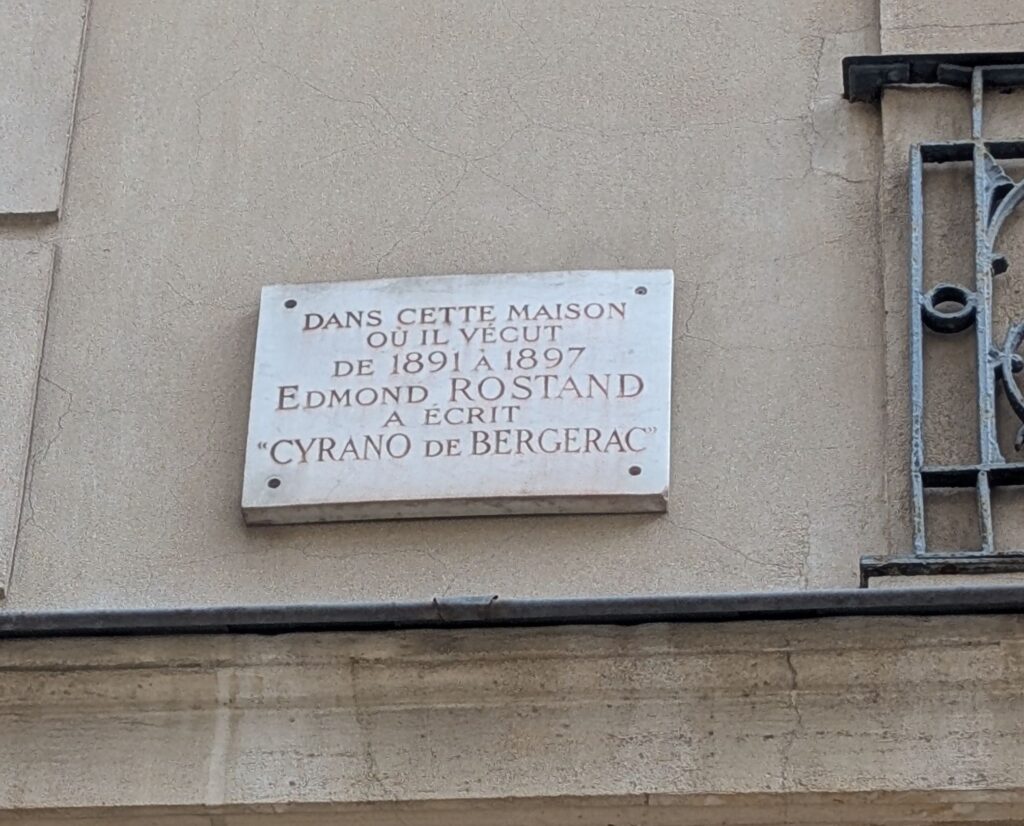
Edmond Rostand, author of “Cyrano de Bergerac,” lived at No. 2, on the corner.
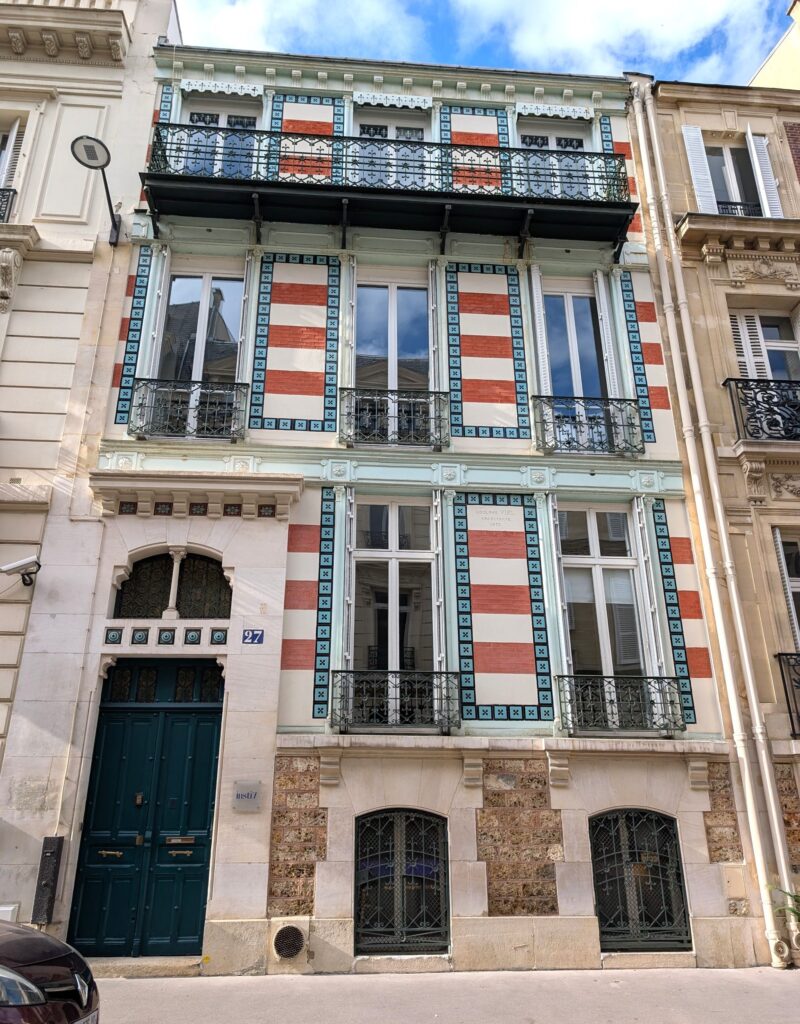
And no. 27 was the home of Caroline Otero, otherwise known as La Belle Otero. She was a Spanish actress, dancer and, as we say, reine de nuit.
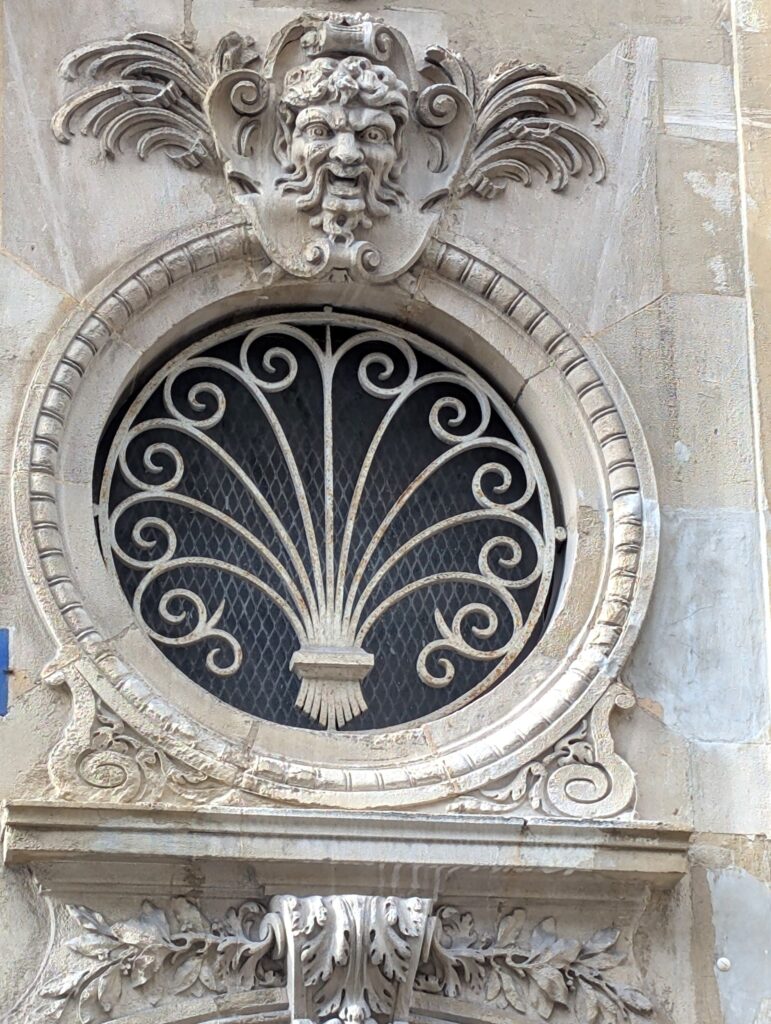
So many of the houses have beautifully painted or sculpted details, like this one at no. 17.
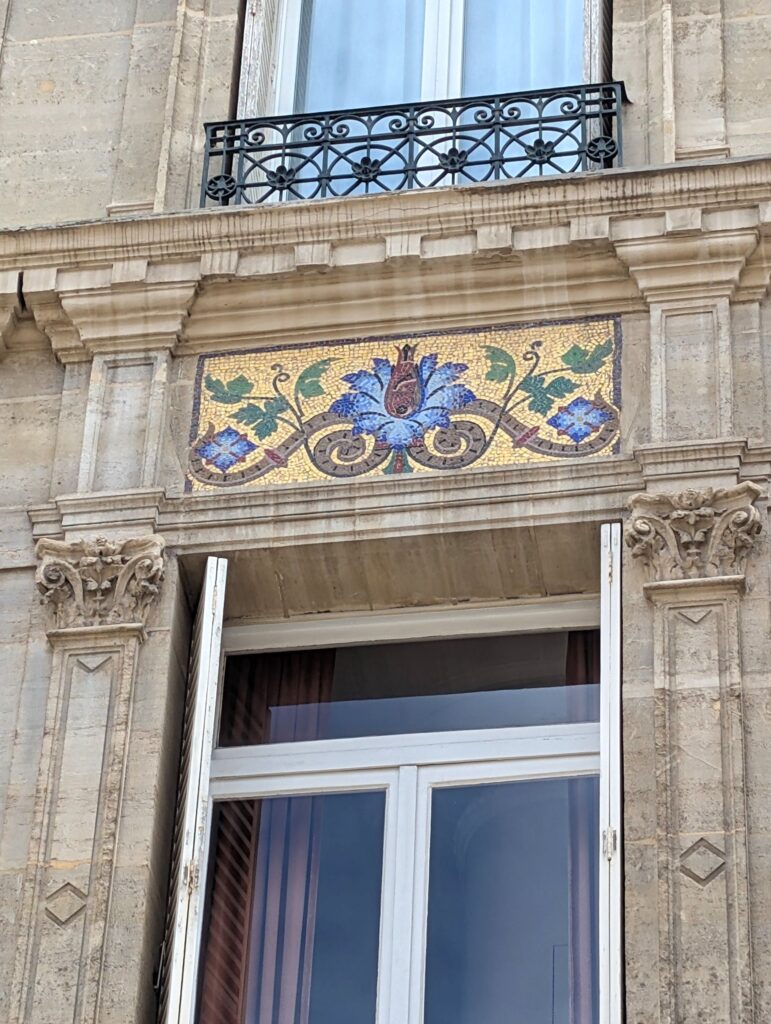
And this one, whose number I failed to record.
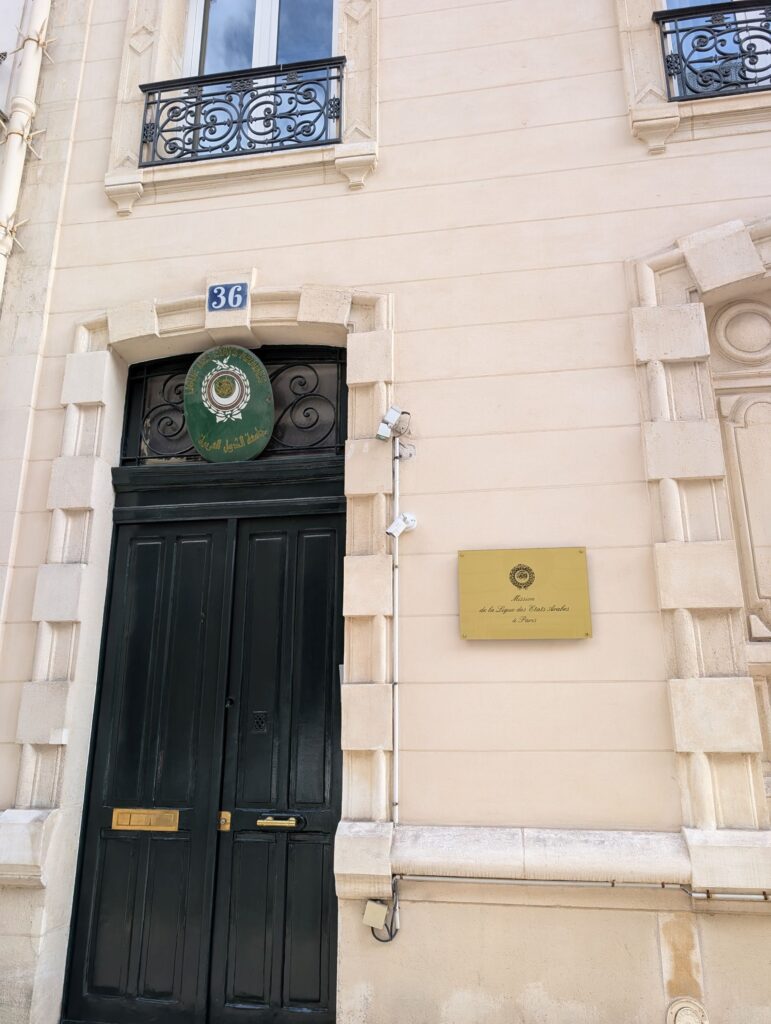
You can’t tell who many of the current tenants are, though the Arab League seems to be here, at no. 36.
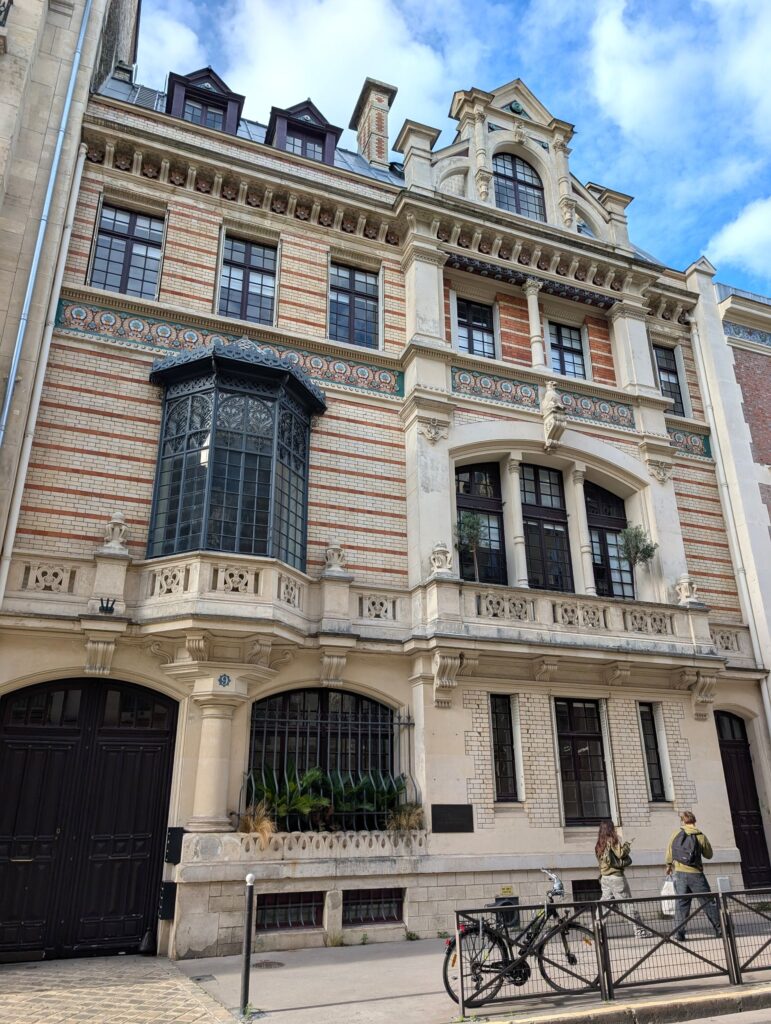
And a technology company operates out of no. 9, one of the most striking buildings—especially its ceramic decorations. It has quite a history. Mariano Fortuny y Madrazo, son of the painter whose name the street bears, founded a fashion school here that trained haute-couture professionals for decades. Mariano fils was an influential figure in Paris fashion and designed the Fortuny pleat. His company still exists. Many architectural features of the building are detailed here.
The street is tiny; you can walk it in five minutes. But I suggest spending more time, looking up houses that strike your fancy and imagining rue Fortuny at the height of its influence. And ask yourself: Are there other obscure Paris streets with rich and little-known histories that you can find?
Thank you for taking us there, Anne.
Next one: showing your Parisienne friends the wonders of East Beverly Street!
Roger
Ha! Think there are a lot of hidden secrets there too? 🙂
Love this! Thanks.
Thank you!
How lovely and informative. I will visit when I’m in Paris in April.
Nice! I’ll go with you if we’re there.
Thanks for the lovey tour Anne. And for doing the research. I’ve always appreciated knowing who, from the past, lived in certain houses and areas of great cities.
Thanks, Pat!
Long admired the buildings on the rue Fortuny and actually once looked at an apartment there!
Wow!
Thanks you, Anne, for an informative piece on a street I have never visited. Perhaps in early December…
Enjoy!
Thank you for “taking us on a tour” of rue Fortuny. It feels so good to go on a short journey “with” you.
Thanks so much, Katie!
I am embarrassed to say that rue Fortuny was wholly unknown to me. Thanks for taking me there….
You are so welcome! I wish I’d mentioned it when you were staying….nearby.
Thank you Anne, for the rare view of Rue Fortuny, and the history behind some of the gorgeous facades.
Thanks, Ginger!
Thank you. Been to Paris frequently, just spent some time there this October. My wife even lived there fir some time. But, unless you actually live there and devote the time to discover, one just scratches the surface. When we arrive, we get immediately absorbed by the city life and leave to soon.
Glad you enjoyed it!